Choosing between Calendly and YouCanBookMe isn’t about basic scheduling—both handle that well. The real difference shows up in how flexible the platform is, how much control you get over your booking experience, and how easily it scales with your business.

We’ve compared them across five areas that actually matter when picking scheduling software:

  1. Ease of use


  2. Scheduling features


  3. Customization options


  4. Integrations


  5. Pricing

Here’s how Calendly vs YouCanBookMe really stack up. 

Comparison summary: Calendly vs YouCanBookMe

Calendly is a scheduling tool with enough features to satisfy varied and complex scheduling requirements. It’s made for enterprises that schedule a lot of external and internal meetings between departments. 

YouCanBookMe, on the other hand, is a customer-focused scheduling platform for small-to-medium businesses. Its mission is to help business owners create a better scheduling experience for their clients—and it has recently released new features to back that up.

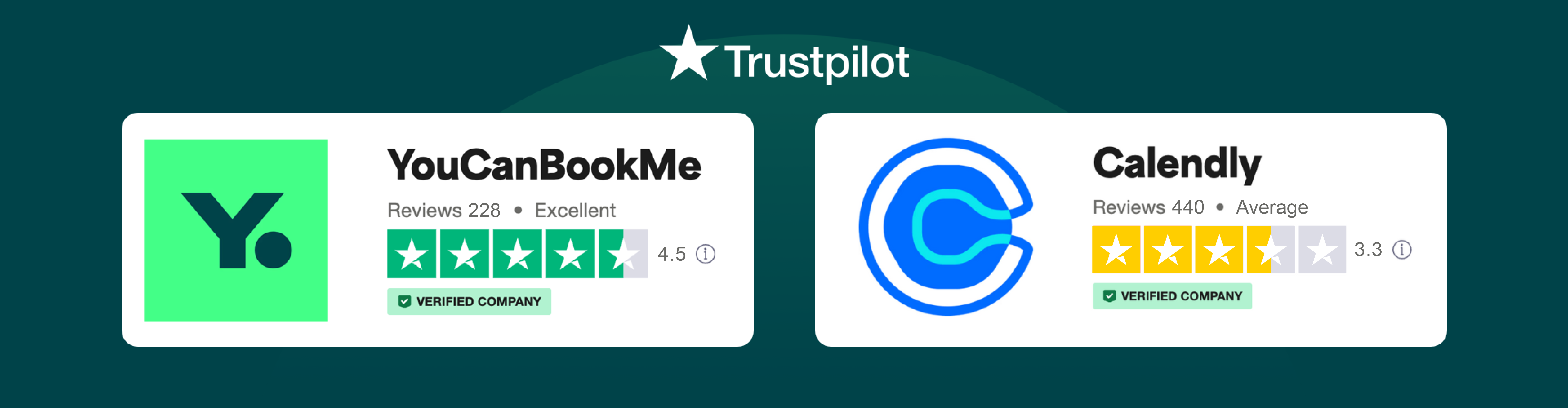
Not only is it super convenient to use, but it packs a lot of powerful features into a hassle-free scheduling solution for creating booking pages quickly and easily. Plus, users LOVE YouCanBookMe. See for yourself. 👇

Trustpilot YCBM vs Calendly
Calendly
YouCanBookMe
Pricing

Offers a free plan. Paid plans are $12/mo and $20/mo per user.

Offers a free plan. Paid plans are $9/mo for 2 calendar connections and $13/mo for 6 calendars. Teams plan starts at $18/mo per user.

Internal set up and collaboration

Modular system (event types, workflows, and routing are controlled separately).

Page-centric editor. Availability, forms, notifications, branding, and team members managed in one place with live preview.

External scheduling and workflow

Routing forms qualify leads before booking. Supports round robin, collective, and group events.

Qualification built into booking page. Supports round robin, priority assignment, pooled availability, blocking questions, and request bookings.

Integrations

150+ native integrations, including enterprise tools.

Core native integrations + Zapier, webhooks, and API. Supports Apple Calendar for new connections.

Customization

Clean, standardized design. Basic branding. 7 invitee languages.

Deeper branding control, multiple appointment types per page, 40+ languages (including RTL scripts).

Best for

Complex and varied meeting scheduling needs for enterprises.

Small-to-mid-sized and international teams wanting flexibility and branding control.

Sign up free No credit card required

What is Calendly?

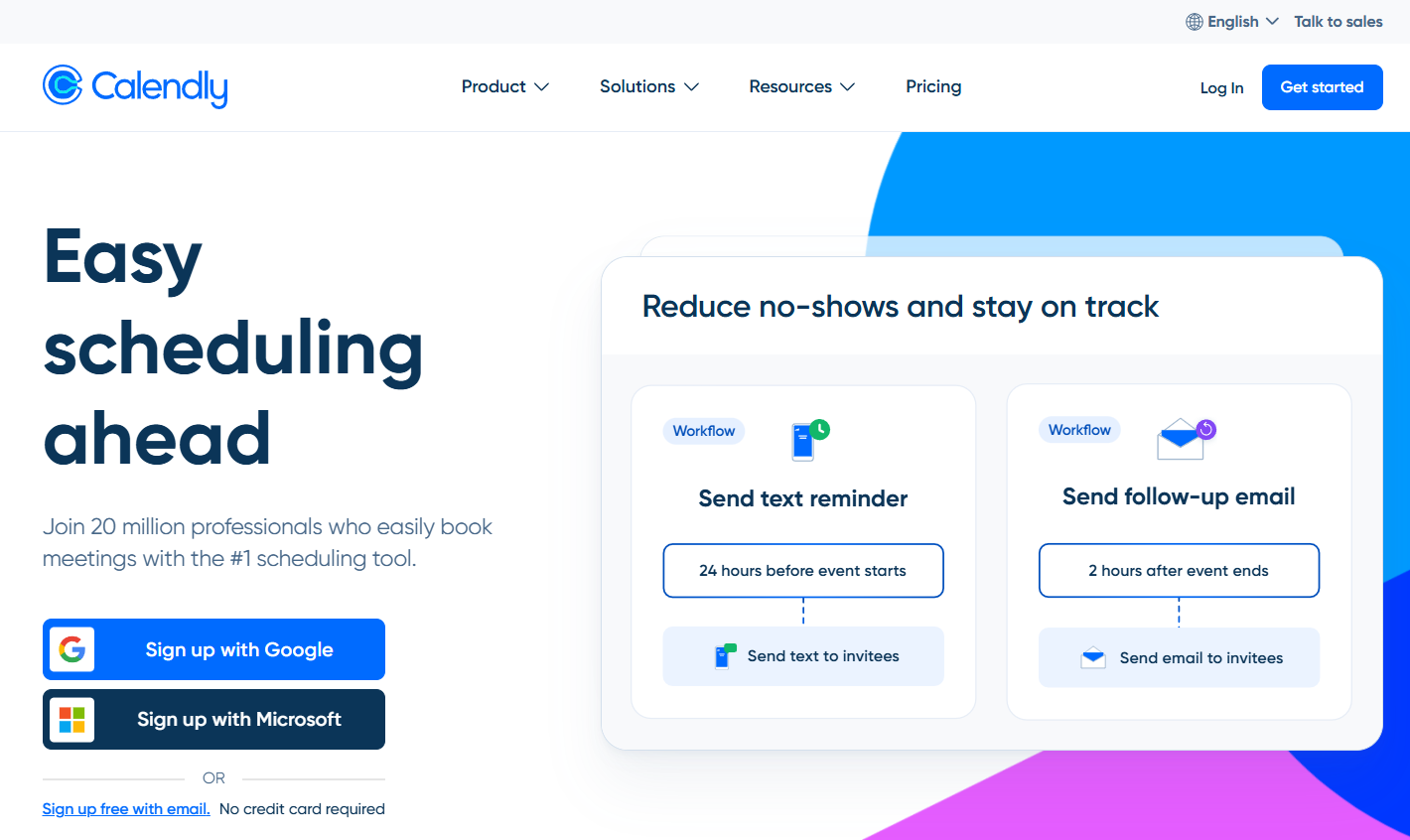
calendly home page

Calendly started out as a simple scheduling link in 2013.

Today, it has grown into a comprehensive scheduling platform that manages scheduling for over 10 million businesses. Calendly places focus on teamwork, with features like pooled availability and the ability to create booking pages for team meetings, webinars, and online classes. It also offers 150 native integrations, which highlights its focus on large teams and complex workflows—something many businesses compare when evaluating Calendly alternatives.

Calendly Pros
Calendly Cons
Wide range of native integrations
Doesn't support new integrations with Apple Calendar
Android and iOS mobile apps
Limited booking page customization and branding
Integrates with PayPal
Decentralized system for creating booking pages "module-by-module"
Pre-booking routing logic
Cannot add more than one event type on the same booking page
What is YouCanBookMe?

YouCanBookMe homepage

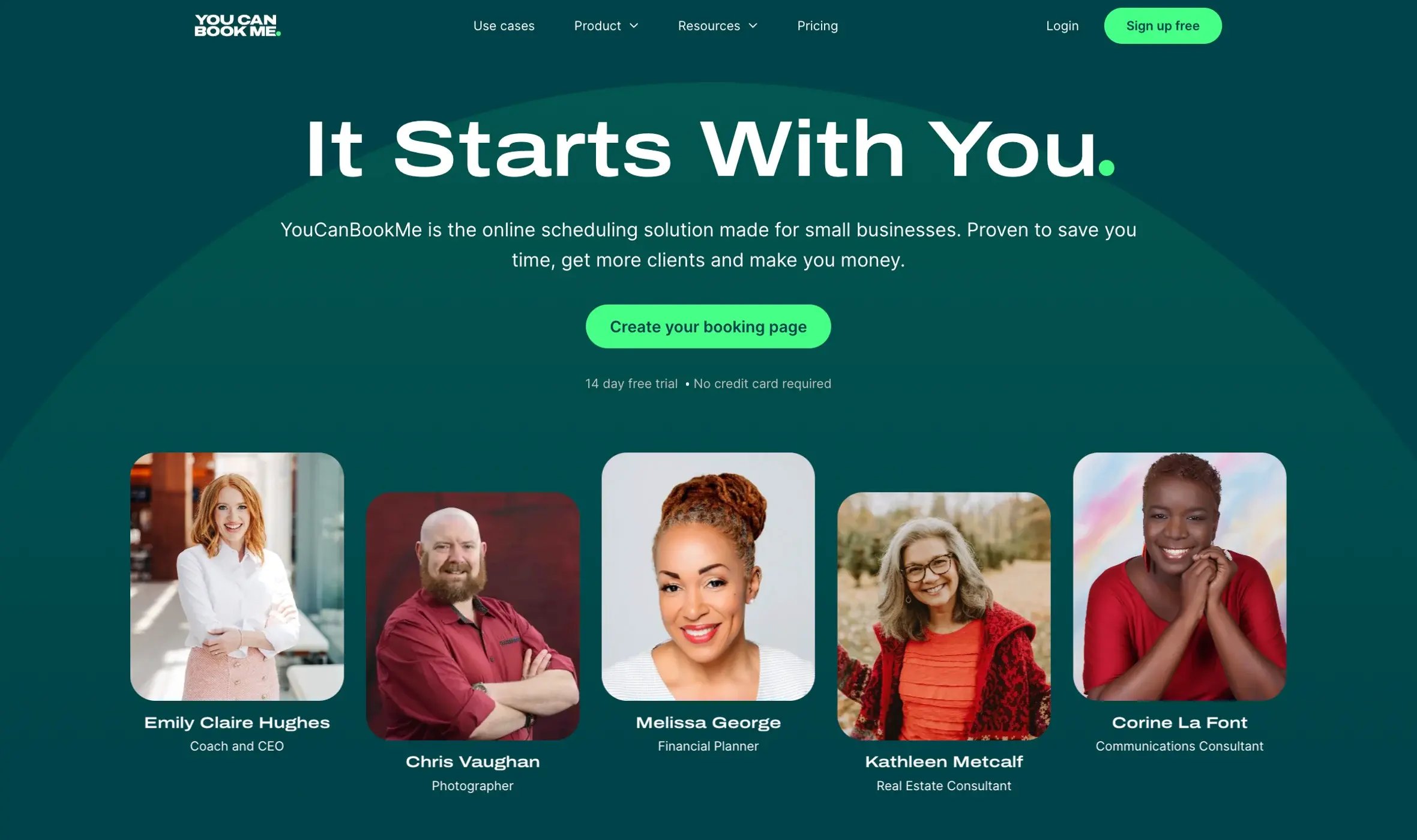
YouCanBookMe was born in 2011 with the main goal of being customer-focused.

Given its attention to customer experience and a user-friendly interface, it has been meeting this goal ever since. It offers a simple pricing structure, with a free option and 3 tiered paid plans. YouCanBookMe is ideal for small-to medium-sized businesses looking to create booking pages on the fly, offering powerful features that businesses appreciate, like different appointment types on the same booking link, payment options like Apple & Google Pay, and the ability to create unique promo codes for clients.

In addition, you get flexible customization options, such as creating booking pages in more than 40 different languages (including right-to-left scripts), custom colors and backgrounds to match your branding, and a fully-customizable footer for your booking page that can display your company information.

Fun fact: YouCanBookMe powers over 1 million bookings per month globally!

YouCanBookMe Pros
YouCanBookMe Cons
Emphasis on creating an excellent booking experience
Not built for large online events (allows max 50 people)
Deep branding control and support for 44 languages
Many integrations rely on Zapier
Centralized system for creating booking pages "as you go"
Pooled availability for teams
Admin controls
Enterprise-grade security (SOC 2 Type II, ISO/IEC 27001, GDPR Compliance)


Listening to your users always pays off

colour_-_4.7_stars
4.7 out of 5 stars — Read all G2 reviews

YouCanBookMe vs Calendly: Pricing

Free plan

If you’re reading this Calendly vs YouCanBookMe comparison to decide between free plans, here’s what both tools include at no cost:

However, when you look a little closer, YouCanBookMe has the stronger free plan. It includes several features that Calendly only unlocks on paid tiers, such as:

  • Setting prices for bookings
  • Accepting payments via Stripe
  • Custom booking forms to screen invitees and collect detailed information
  • Calendar overlay, which lets invitees layer their own calendar on top of your booking page so they only see times that work for both of you

In short, while both tools are usable for free, YouCanBookMe gives you more flexibility and control without upgrading.

YouCanBookMe paid plans start at $9 per month (billed monthly); Calendly starts at $12 per seat per month (billed monthly).

Calendly
YouCanBookMe
Free plan

1 booking page, 1 linked calendar integration, meeting polls, single-use links, video conferencing

1 booking page, 1 linked calendar integration,  custom logo & text, booking form questions, payment collection via Stripe, polling, meeting confirmations

Starter plan

$12/seat/month: Connect multiple calendars, unlimited event types, PayPal & Stripe integration

$9/month: 2 linked calendars, 2 booking pages, custom colors & backgrounds, multiple availability displays (month/week/day), password-protected pages

Professional

-

$13/month:6 calendars, 10 booking pages, unlimited workflows, accept/reject bookings, no-show tracking, Google Analytics & social pixels, HubSpot integration
Team

$20/seat/month: Round-robin meetings, Salesforce routing, lead qualification forms, Marketo & Pardot integrations, SSO

$18/seat/month: Role-based access, team round robin, list multiple team members on one page, centralized billing, unlimited API access, personalized onboarding
Annual discount
20%
10%
2-year discount
20%
Sign up free No credit card required

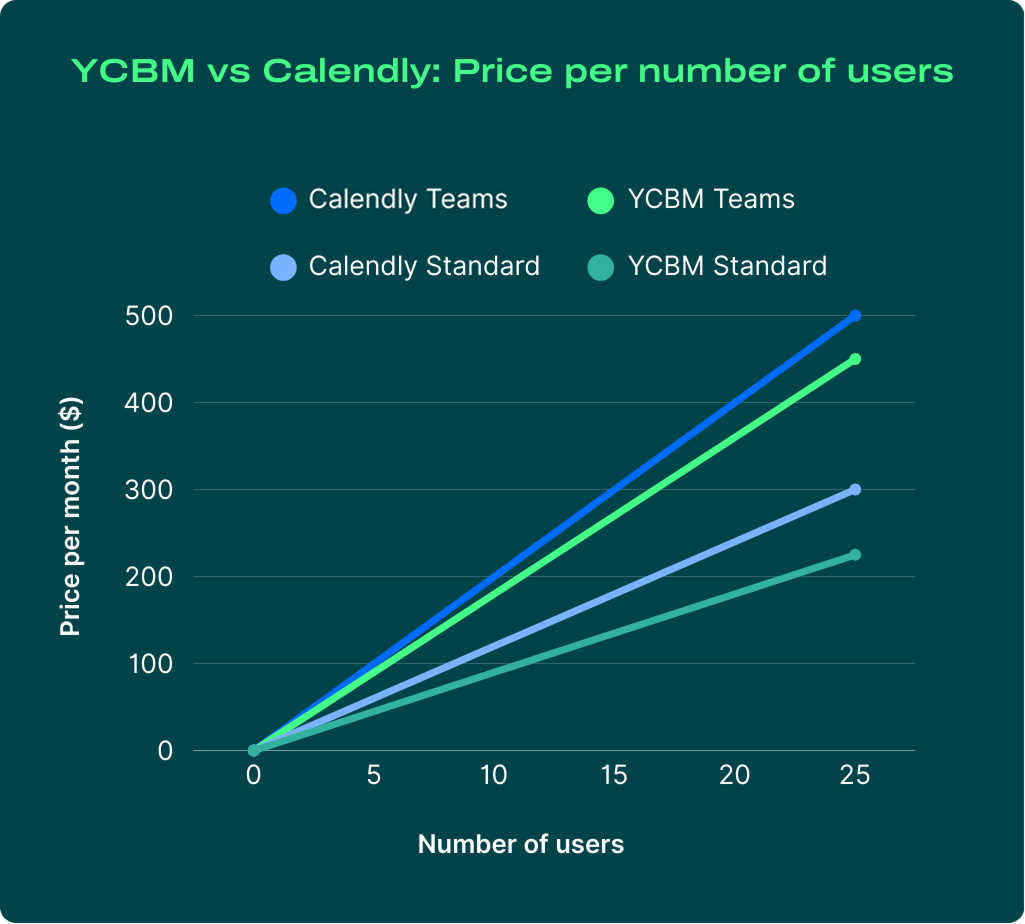
YouCanBookMe is less expensive than Calendly on all plans, meaning you get powerful features while saving your business money.

YCBM vs Calendly price graph

Winner: YouCanBookMe

Individuals who just need one linked calendar will unlock more customization abilities at just $9/month. Also, small-to-medium businesses will find YouCanBookMe less expensive than Calendly's Team plans with the same set of features.
Calendly vs YouCanBookMe: Internal setup and collaboration

Booking page setup and workflow structure

YouCanBookMe and Calendly take different approaches to how booking pages are built and managed.

YouCanBookMe

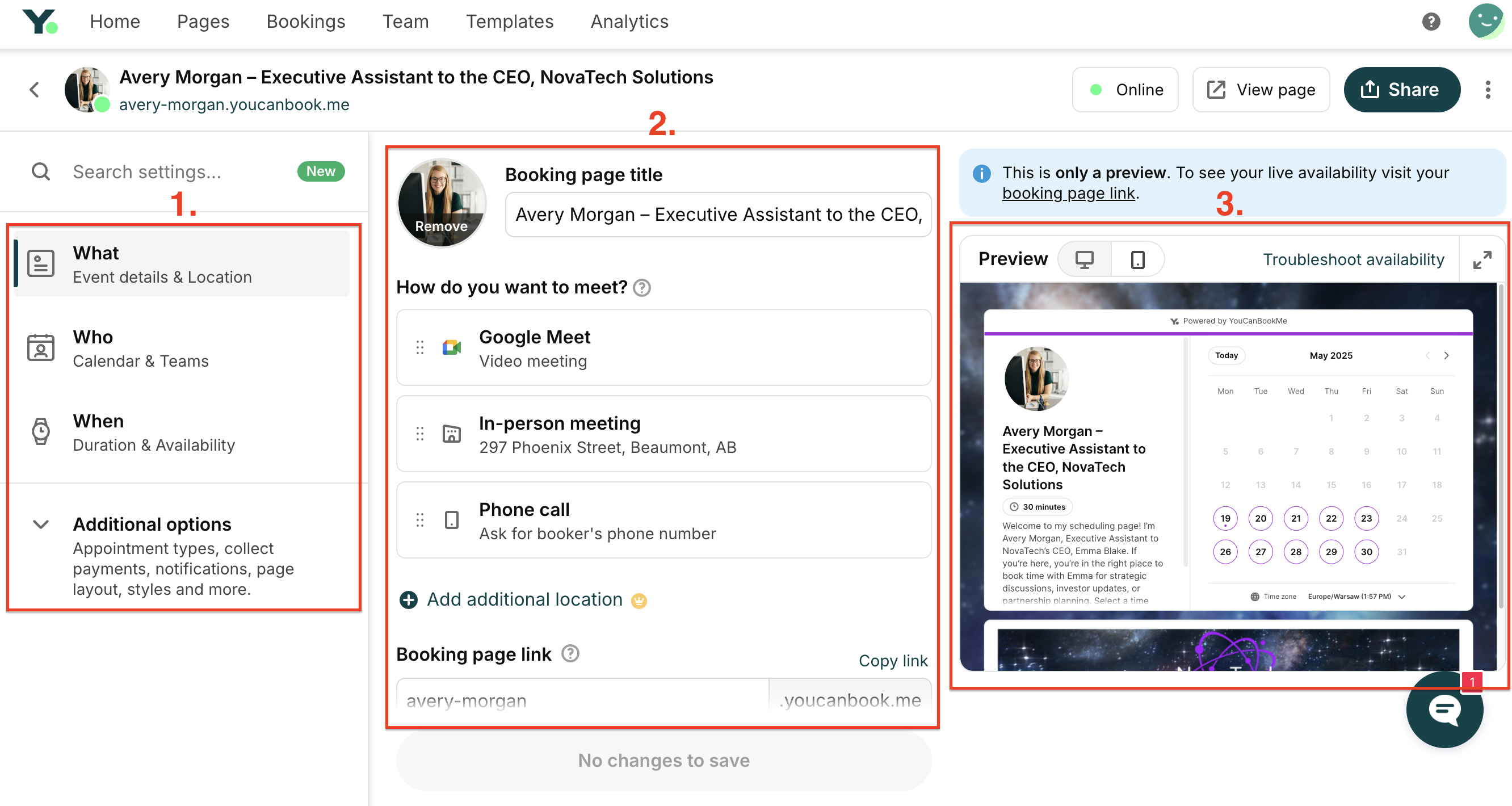
In YouCanBookMe, all the tools needed to create and manage a booking page are accessible from within that page’s editor.

From the left-hand menu (1), you can configure:

You also get a live preview (3) of the booking page as you build it—so you can see exactly how it will look once published.

Each booking page is self-contained. Different pages can have different branding, images, forms, booking links, and assigned team members without affecting other pages.

YouCanBookMe booking page settings

Calendly

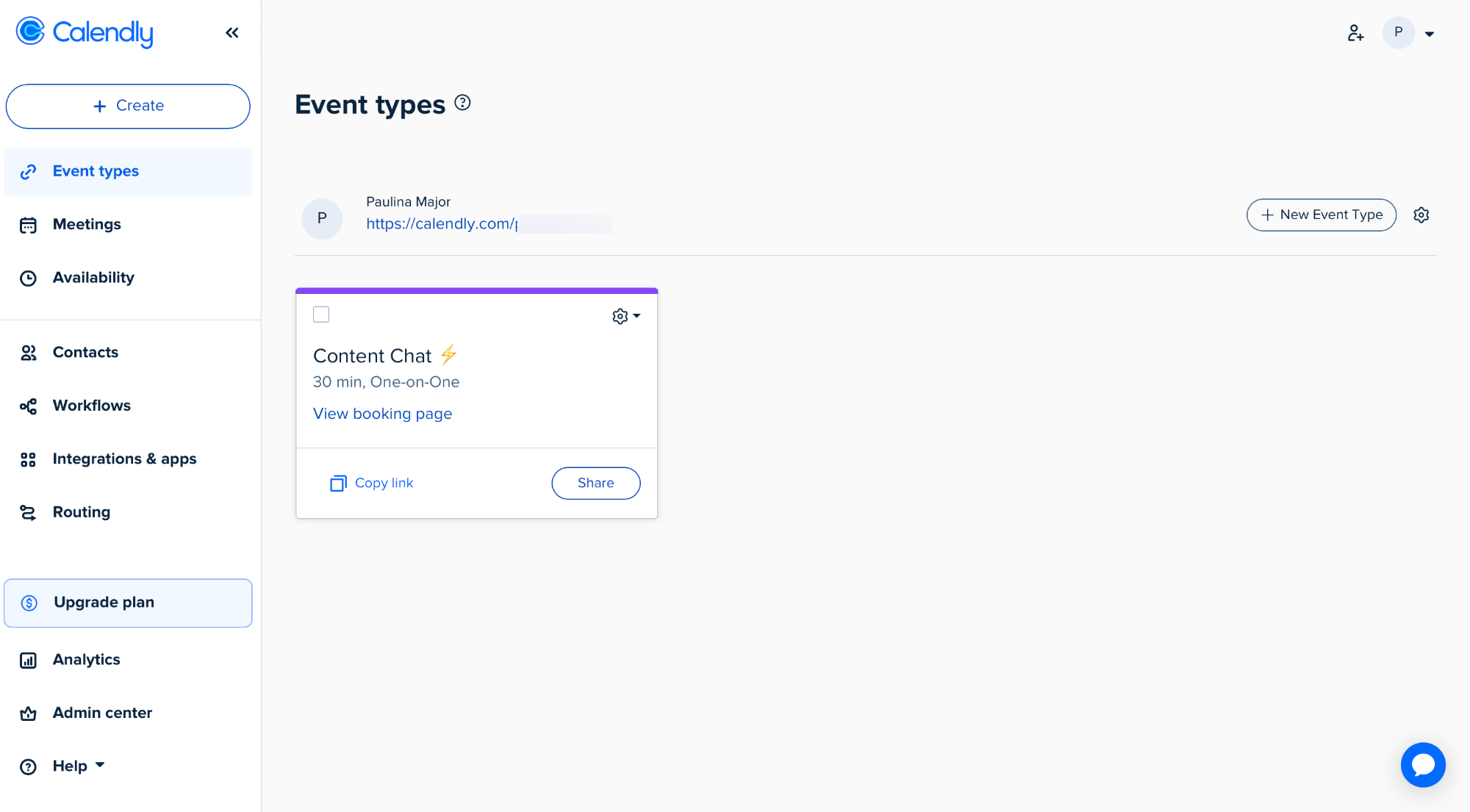
Calendly uses a more modular structure.

You create booking pages as “Event Types” from the dashboard. However:

  • Notifications (called Workflows) are managed in a separate section
  • Routing forms live in their own area
  • Some branding and appearance settings are controlled at the account level, and you cannot customize them for different pages

This structure keeps things organized, especially for larger teams—but it does require switching between different parts of the dashboard when configuring a full booking flow.

calendly booking page setup

Quick summary

YouCanBookMe keeps everything related to a booking page in one place. Availability, forms, notifications, team assignments, and appearance are all managed inside the same editor, with a live preview as you build.

Calendly separates events, workflows, routing, and some branding settings into different modules. While this structure can work well for large organizations managing standardized processes, it often requires moving between multiple sections to fully configure a booking flow.


Spend less time configuring. More time booking.

Manage every part of your scheduling experience from one powerful page editor.

Get started (it's free!)
customize every aspect of your availability

Analytics

Both Calendly and YouCanBookMe provide core booking analytics, but neither is designed to replace a CRM or dedicated analytics tool.

Calendly

Calendly focuses on scheduling activity and team performance.

You can track:

  • Created, completed, rescheduled, and canceled events
  • Popular event types and booking times
  • Event distribution by duration

Admins can filter by date, user, team, group, and event type.

On Teams plans and above, you also get routing form analytics, showing how form submissions convert into meetings.

Data can be exported to CSV for further reporting.

Calendly’s reporting is especially useful for tracking team scheduling trends and routing performance.

YouCanBookMe

YouCanBookMe focuses more on booking trends and business impact.

You can track:

You can export data instantly—or schedule weekly/monthly automated exports.

YouCanBookMe’s analytics lean more toward operational and revenue insights, particularly useful when bookings directly drive income.

Winner: YouCanBookMe

If you’re a small-to-medium-sized business, YouCanBookMe’s all-in-one booking page editor makes setup and management simpler, with everything related to a page in one place.

Its analytics also emphasize booking trends and revenue visibility—useful if meetings directly drive your income.

Calendly vs YouCanBookMe: External scheduling workflow

Appointment and event types

YouCanBookMe

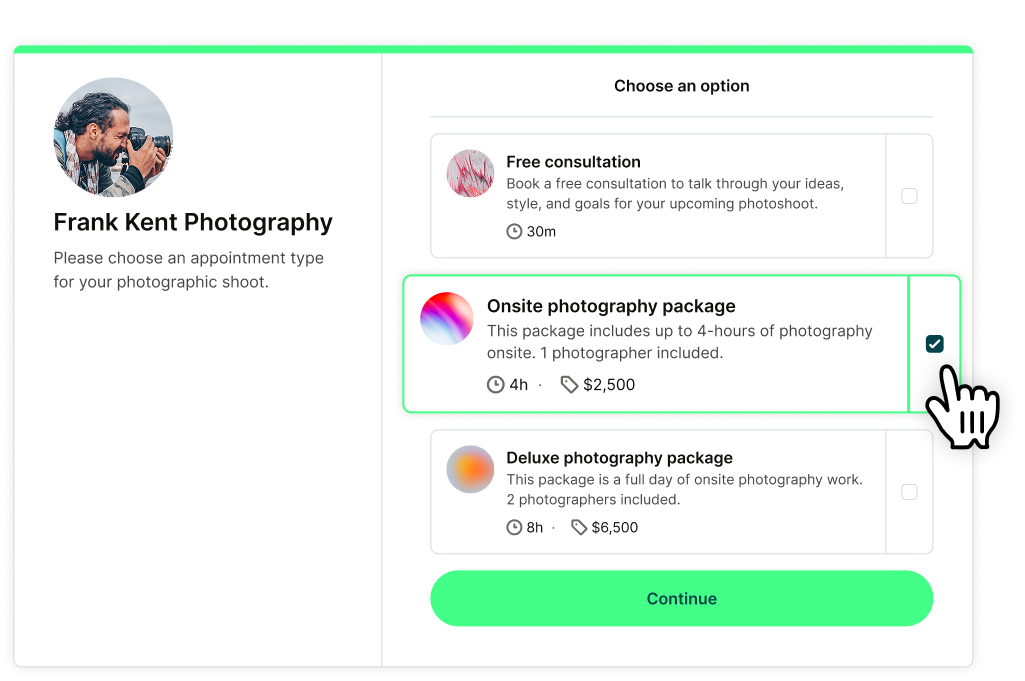
With YouCanBookMe, you can add multiple appointment types to a single booking page.

For example, you might offer a 15-minute intro call, a 60-minute consultation, and a paid strategy session—all neatly listed in one place. Your clients (or team members) simply choose the option they need.

We could put out all of our list of services so our clients could see exactly options they wanted. And it was just so easy and seamless. I still think it's one of the best and easiest programs to use.”

- Angela Princewell, Founder of AP Lawyers

Calendly

With Calendly, although you can create different event types, you can’t display multiple ones on the same booking page.

Each event type requires its own separate link and page. That means if you offer several services, you’ll need to send different links—which can feel fragmented and less convenient, especially for consultants or service-based businesses.


One link. Every meeting type.

Stop sending multiple booking links and start giving bookers a seamless way to choose exactly what they need.
Get started (it's free!)
Customize your booking page with appointment types

Team scheduling and pooled availability

Both tools let multiple team members share availability on a booking page. But they handle it differently.

YouCanBookMe

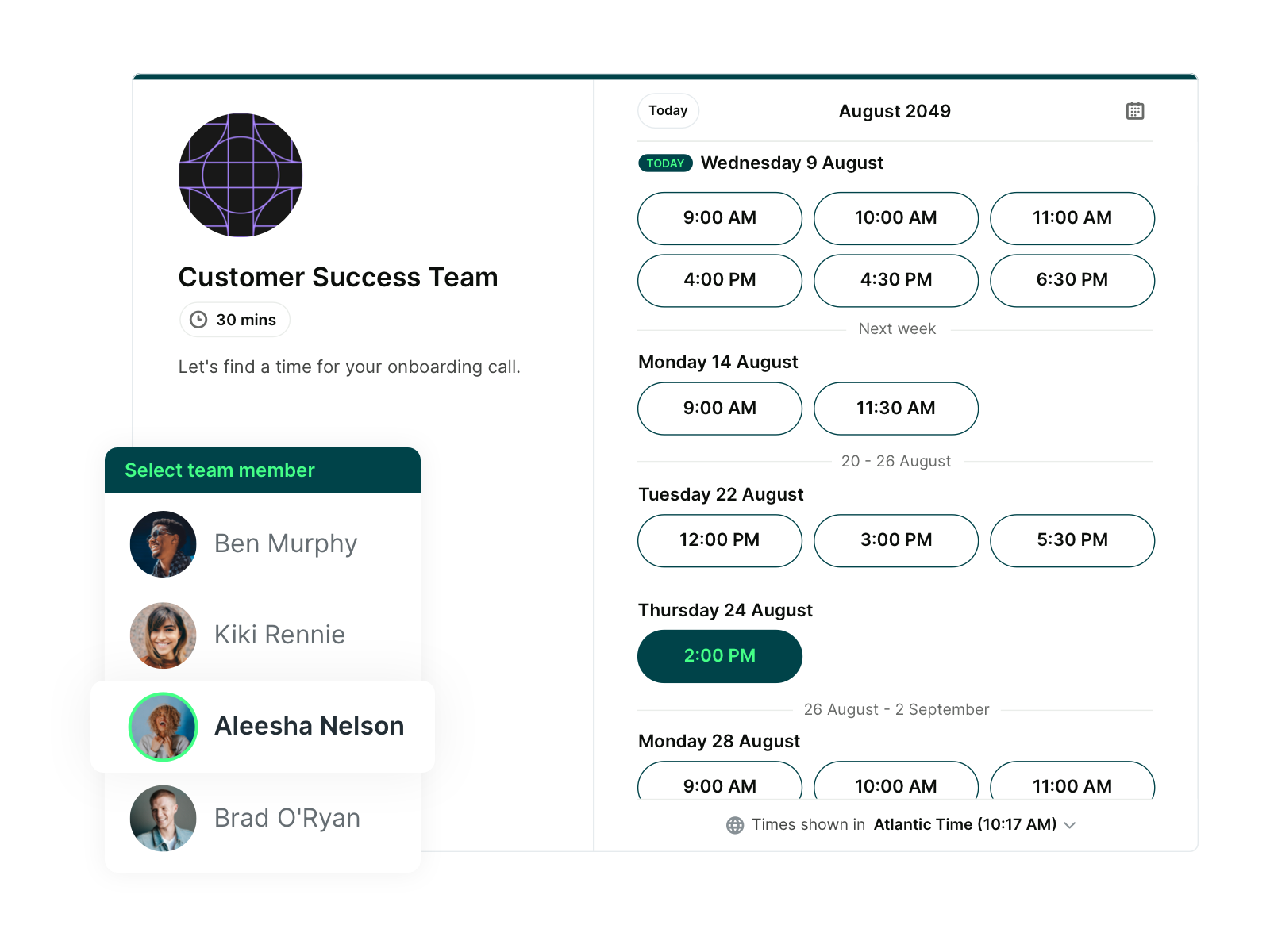
With YouCanBookMe, you can put multiple team members on one booking page and choose how bookings are assigned:

  • Let the client pick the person they want to meet
  • Automatically assign meetings using round robin scheduling
  • Automatically assign based on priority rules

In other words, you can offer both choice and automatic distribution from the same page.

This is especially helpful for service, support, or sales teams that sometimes want to route leads automatically—but other times want clients to choose a specific specialist.

team member selection youcanbookme

Calendly

In Calendly, team scheduling works through different event types:

  • Round robin events → automatically assigns the meeting to an available team member
  • Collective → requires multiple team members to attend
  • Group → one host, multiple attendees

If you use round robin, the client cannot choose a specific team member—the system assigns one automatically.

If you want clients to choose who they meet with, you’ll need to send separate booking links for each person (or list separate event types on a team page).

Similar to how Calendly handles event types, this means creating separate flows for different scenarios, rather than offering multiple options within a single booking page (like YCBM does).

Routing and lead qualification

Both Calendly and YouCanBookMe let you ask questions before someone books. The difference is where and how that qualification happens.

Calendly: Qualify first, then send to a calendar

Calendly uses something called a routing form.

Think of it like a short questionnaire someone fills out before they ever see available time slots.

Based on their answers, Calendly automatically sends them to:

  • A specific team member
  • A round robin calendar
  • A different booking page
  • Or even an external page (like a help center)

It’s a “fill this out first, then we’ll tell you where to go” system. This works well for sales teams handling and tracking inbound leads.

calendly routing form

YouCanBookMe: Qualify directly inside the booking page

With YouCanBookMe, qualification happens within the booking page itself—not in a separate routing step.

Instead of sending someone to a standalone form first, you add custom lead-qualifying questions directly to the booking form. These can cover things like budget, timeline, company size, or specific needs.

You also have more control over what happens next:

  • Blocking questions can automatically prevent someone from booking if they don’t meet your criteria.
  • Request bookings let you review answers first and decide whether to approve the meeting.
customizable booking forms in youcanbookme

Behind the scenes, you can collect additional data—such as referral source, campaign ID, or other metadata—without asking the booker to fill in extra fields. That information can trigger automations, notifications, or internal workflows.

You can also:

  • Prefill known details (like name or email) when linking from your CRM or email campaigns, reducing friction.
  • Use conditional logic to show or hide questions based on previous answers, keeping the form short, relevant, and personalized.

Winner: YouCanBookMe

It lets you manage multiple appointment types, team options, and qualification tools on a single, fully customizable booking page. With stronger branding control, broader language support, and built-in revenue insights, it offers a more flexible and complete scheduling solution for most growing businesses.

Calendly vs YouCanBookMe: Integrations

Both Calendly and YouCanBookMe cover the core integrations most teams rely on:

  • Calendars: Google, Outlook

  • Analytics: Meta Pixel, Google Analytics

  • CRM: HubSpot

  • Payments: Stripe

  • Video conferencing: Zoom, Google Meet, Microsoft Teams

Bonus: both platforms offer a handy scheduling Chrome extension for quick access from your browser!

Calendly

Calendly has the edge when it comes to the sheer number of native integrations, with 150+ direct connections, including enterprise platforms like Okta.

This makes it particularly attractive for large organizations with complex tech stacks that prefer built-in, native integrations across their ecosystem.

YouCanBookMe

While YouCanBookMe offers fewer native integrations than Calendly, it can connect to the same tools through Zapier and its API.

It also has one important native scheduling integration that Calendly no longer supports for new connections: Apple Calendar.

Winner: Calendly

If you want a large ecosystem of built-in, native integrations out of the box, Calendly currently has the edge. If you're comfortable using Zapier or API-based workflows, YouCanBookMe can connect to just as many tools—but sometimes through automation rather than direct integrations.
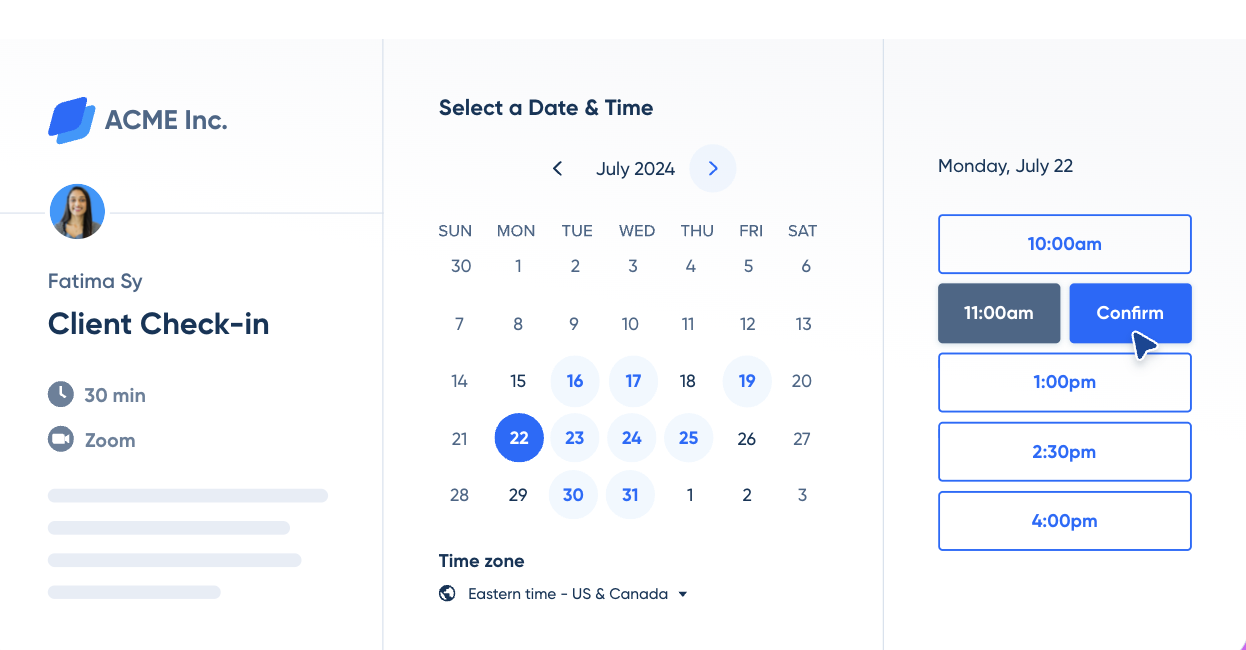
YouCanBookMe vs Calendly: Customization

Customization is one of the clearer differences between Calendly and YouCanBookMe—but it’s about degree, not capability vs. no capability.

Both tools allow branding and personalization. The difference is how much control you get.

Language support

If you work internationally, language flexibility matters.

YouCanBookMe supports booking pages in 44 languages, including right-to-left scripts, and covers dialects across 100+ countries.

Calendly currently offers 7 invitee language options.

For globally distributed teams or international clients, YouCanBookMe provides significantly broader language coverage.

I have people from the Netherlands who use euros and Dutch as their language, but also people internationally who use dollars and speak English. I needed the flexibility to set the currency and the language per booking page. And with all the other tools, I could only set that per account.”

Roel van Gorkum, Founder of Still Tinnitus

Visual branding and page control

Both platforms allow:

  • Custom booking page URLs
  • Logo uploads
  • Brand color customization
  • Custom confirmation messages
  • Automated notifications

Calendly does allow brand color customization (primarily one primary color), especially on paid plans.

Calendly booking page example

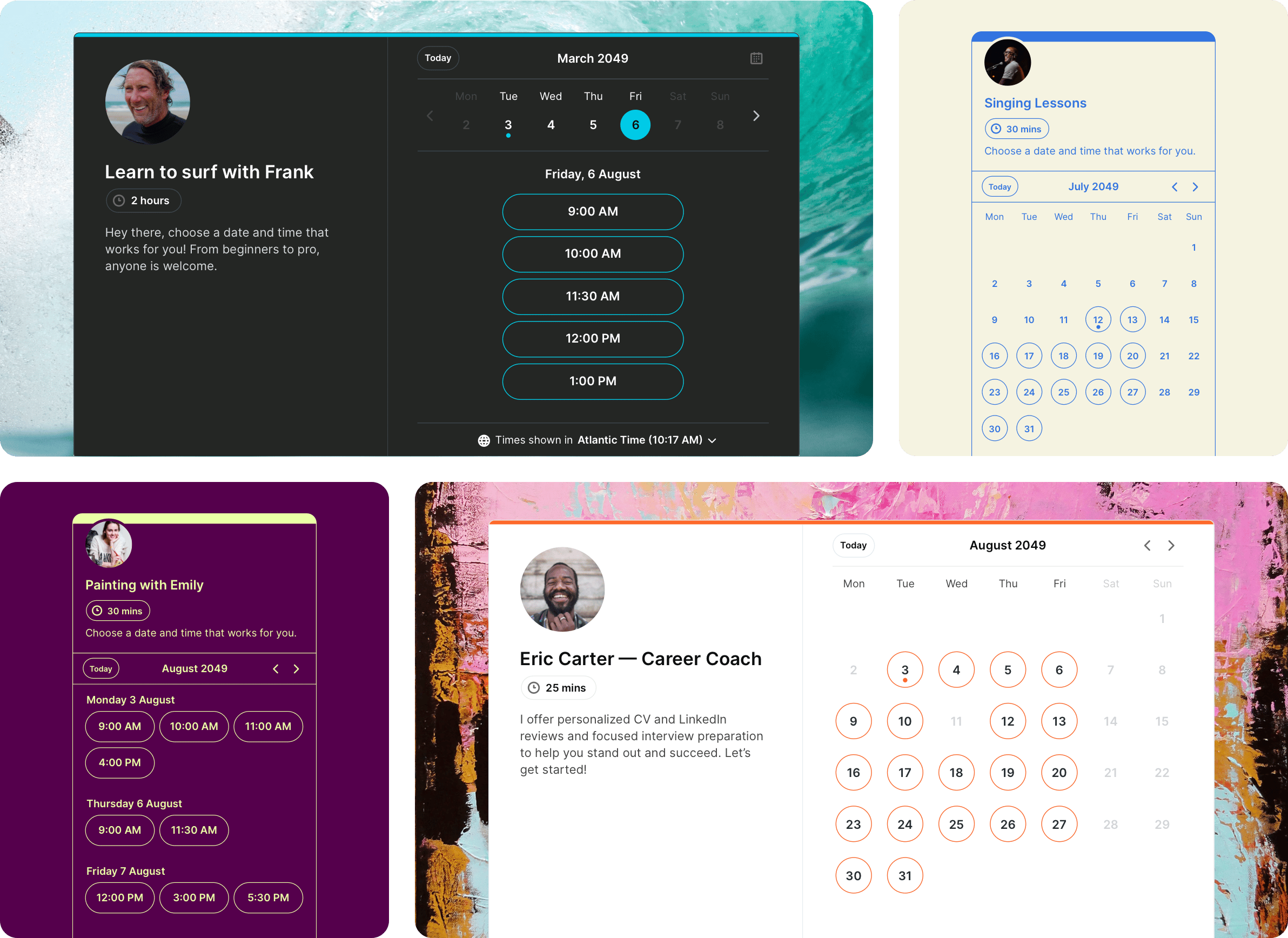
When it comes to visual customization, many teams looking for a solution better than Calendly choose YouCanBookMe for its deeper design control.

YouCanBookMe offers more extensive visual control, including:

  • Customizing more page elements
  • Displaying availability by month, day, or agenda
  • Editing most visible text
  • Adding richer descriptions and images
  • Adding custom footer content (contact info, links, etc.)
  • Adding custom backgrounds and different booking page themes

The result is that with YouCanBookMe, you can truly make your booking page reflect your brand.

I love that you could customize it. I love that it had personality. And I love that it was more fun than Calendly."

Emily Claire Hughes, Founder of Emily Claire & Co.

customized youcanbookme booking pages
💡 See how 9 YouCanBookMe power users have customized their booking page to feel like an extension of their brand.

Embedding options

For embedding, Calendly and YouCanBookMe are very similar. Both let you add scheduling directly to your website in the common formats most teams need:

  • Inline embed (the scheduler sits directly on a webpage)
  • Popup/modal embed (opens the scheduler in an overlay)
  • Button or text link that triggers the popup
  • Standalone booking link (send or link anywhere)

Both also support URL parameters, so you can do things like:

  • Prefill fields (name, email, answers to questions)
  • Capture hidden fields / tracking data (like UTMs, campaign source, referrer info)

The practical difference

The embed methods themselves aren’t a major differentiator. What changes is the experience you’re embedding:

  • Calendly embeds are straightforward and consistent, and you typically embed an individual event type (or a team/shared event flow).
  • YouCanBookMe gives you more control over the look, text, and structure of the embedded booking page—and can be especially useful if you want a more branded page or multiple service options presented together.

Winner: YouCanBookMe

Although you can customize the look of your booking page with both YouCanBookMe and Calendly, YouCanBookMe takes the win here because of its emphasis on the booking experience, the variety of language options, and the extensive customization options.

Final verdict: YouCanBookMe vs Calendly

Calendly
YouCanBookMe
Customization & branding

Limited, paid plan only

Footers and extra customization

Customize 'offline' messages


Block emails & domains

Request-only bookings
Multiple appointment options on the same link
Choice of availability displays
Availability overlay
Only for other Calendly users, not mobile friendly
Over 40 languages supported, including Right-to-Left scripts
7 languages
Modern Zapier integration
Not as customizable
HubSpot integration
Not as customizable
Sign up free No credit card required

Use Calendly if:

  • You manage scheduling across multiple departments and need structured routing
  • You want to natively connect your appointment scheduling software with a wide range of other software

Use YouCanBookMe if:

  • You want full control over your booking page and availability
  • You offer multiple services or appointment types and prefer them on a single booking page
  • You care about branding, personalization, and international language support
  • You’re a small-to-mid-sized team looking for powerful scheduling at an affordable price
Calendly
YouCanBookMe
Best for

Enterprise businesses that need to manage many departments and integrate with their tech stack hassle-free.

Businesses that want full control over their booking experience, with flexible scheduling, strong branding options, and multiple services managed on one seamless page.
Sign up free No credit card required

FAQ

Can I use either tool for free?

Black Arrow Icon

Yes. Both Calendly and YouCanBookMe offer free scheduling plans with core features.

However, YouCanBookMe’s free plan is more generous in several key areas. It allows you to set prices and accept payments via Stripe, create custom booking forms to screen invitees, and use features like calendar overlay—which lets bookers compare their availability with yours. All of these features require a paid plan in Calendly.

While both free plans are suitable for basic scheduling, YouCanBookMe provides more flexibility and functionality before you need to upgrade.

How customizable are the booking pages?

Black Arrow Icon
Both Calendly and YCBM allow branding customization, including logos, colors, and messaging.

YouCanBookMe is known for offering deeper customization—including editable page text, custom footers, multiple appointment types on one page, custom colors and backgrounds, and broader language support. Calendly provides a clean, more standardized design with lighter branding control.

Customization options increase on higher-tier plans for both tools.

Is my data secure on these platforms?

Black Arrow Icon

Both Calendly and YouCanBookMe use industry-standard security measures, including SSL encryption and secure data infrastructure, and both are GDPR-compliant.

If formal accessibility documentation is important to your organization, there is a difference to note: YouCanBookMe is renewing its VPAT (Voluntary Product Accessibility Template), while Calendly is not currently renewing its VPAT documentation.

For enterprise teams or public-sector organizations that require up-to-date accessibility compliance documentation, this may be an important differentiator.

Can I use these tools for both client-facing and internal scheduling?

Black Arrow Icon

Yes. Both Calendly and YouCanBookMe support external client bookings and internal team scheduling.

You can create different event or appointment types for sales calls, consultations, internal meetings, interview scheduling, and more.

Get started today

Join thousands of coaches, consultants, and entrepreneurs who use YouCanBookMe to power their business. Get your first booking in a few minutes.

Create your own booking page
14 day free trial No credit card required