
The Management Meeting Playbook: How to Run Better Meetings


Create your free booking page
Think about your last management meeting. Did it end with clear decisions, assigned actions, and a sense of momentum—or with vague agreements and lingering confusion?
For many teams, meetings have become habitual rather than intentional. They happen because they’re scheduled, not because they’re needed.
But effective managers know that every meeting should have a clear job to do. It should:
- Solve a problem
- Drive important decisions
- Create alignment that couldn’t happen otherwise
If these things aren’t happening, your management meeting is…broken. If you want to fix it, keep reading. We’ll walk you through how to run these meetings more effectively, and share proven frameworks, ready-to-use agendas, and best practices—so every meeting delivers clear decisions and measurable progress.
A management meeting is a type of meeting where organizational leaders come together to align on strategy, review performance, and solve cross-functional issues.
Unlike broader team meetings, a management meeting is typically limited to senior stakeholders such as executives, department heads, and directors. The goal is not to share updates, but to make decisions, resolve problems, and ensure the business is moving in a unified direction.
Management team meetings differ a lot from staff meetings or all-hands meetings. Here's a quick table explaining the difference:👇
|
Meeting type |
Who attends |
Purpose |
Cadence |
Output |
|
Management meeting |
Executives and C-suite leaders, department heads, directors, or functional leaders |
Align strategy and solve key issues |
Weekly or biweekly |
Decisions, priorities, actions |
|
Staff meeting |
Individual teams or departments |
Share updates and coordinate work |
Weekly |
Status updates, team alignment |
|
All-hands meeting |
Entire company |
Communicate company-wide updates and vision |
Monthly or quarterly |
Awareness, transparency |
Most management meetings do one of two things: they either drive the business forward or quietly slow it down.
👉 In high-functioning teams, the meeting is where issues are solved, priorities are clarified, and accountability is reinforced.
👉 In struggling teams, it becomes a loop of updates, unresolved problems, and repeated conversations.
When a management meeting is working as intended, it becomes the place where the business actually gets run, leading to:
Faster decisions
The team brings the most important issues into the meeting and works through them with the right context and people in the room. Then, discussions take place, leading to clear outcomes, whether that is a decision, a next step, or an assigned owner. Problems do not carry over week after week.
Cross-functional alignment
A management meeting is where leadership aligns on a few critical decisions each week (or whatever is your meeting cadence), like which customer segments to prioritize, which deals matter most, and where to focus resources.
When those decisions are clear, each team can execute accordingly. For example, if your leadership aligns on focusing on enterprise customers:
-
sales can prioritize larger deals,
-
marketing can tailor messaging to that audience,
-
and product can invest in features that support enterprise use cases.
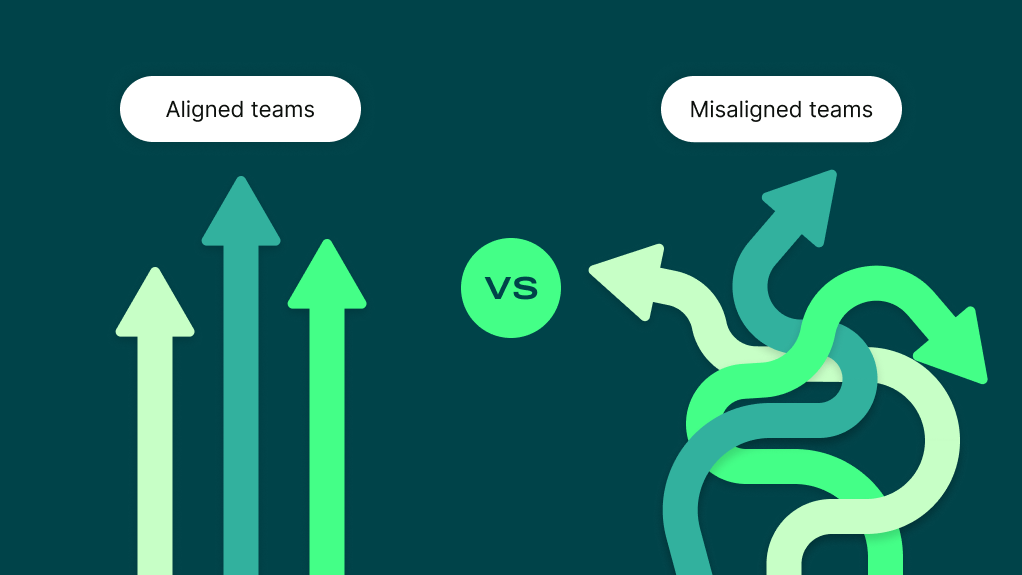
When that alignment is missing, teams default to their own assumptions. And that could look something like sales chasing short-term revenue in one segment, while marketing is positioning for a different audience. On the surface, each team is making reasonable decisions, but they aren’t connected.
Want a visual example of what aligned vs. misaligned looks like? It’s something like this 👇
Stronger execution across the organization
A good management meeting also closes the gap between talking about work and actually getting it done. You should aim to end every discussion with a clear owner and a clear next step. Avoid all the ambiguity and all the bold claims of “we’ll circle back.”
The ownership shouldn’t stay at the leadership level either. Right after the meeting, it should cascade into teams, making priorities visible and measurable across the organization.
When a management meeting breaks down, it’s usually because of several predictable reasons:
- No meeting agenda or a vague one: Without a clear structure, the meeting lacks direction from the start. Conversations jump between topics or get driven by whoever speaks first. This makes it difficult to prioritize what actually matters or reach meaningful outcomes.
- Wrong people in the room: If key decision-makers are missing, progress stalls because decisions cannot be made. If too many people are included, discussions slow down and lose focus. The right balance is a small group of leaders who both own priorities and can act on decisions.
- Status updates take over (no real decisions made): Time gets spent reviewing what has already happened instead of addressing what needs to be solved. Issues are mentioned but not worked through. The meeting becomes informational rather than operational.
- No follow-through on action items: Decisions without ownership rarely translate into execution. If there is no clear owner or timeline, work gets delayed or forgotten.
- Approaching the meeting with blame instead of curiosity: When company results are off, conversations can quickly become defensive. This naturally limits honest discussion and prevents teams from getting to the root of the issue. A blame-driven environment reduces trust and slows problem-solving.
|
💡 A quick principle to follow: As much as we would like it to, performance will not always trend upward. Some teams will grow, others will plateau, and some will fall behind. For those presenting updates, come prepared with context. Explain not just what is happening, but why. For everyone else in the room, approach the conversation with curiosity, not blame. The goal is to understand the situation and solve the problem, not assign fault. |
- The meeting isn’t set up for success: In many cases, these issues start before the meeting even begins. If scheduling is disorganized, the wrong people get invited, key stakeholders drop off, or meetings get squeezed into whatever time is available rather than when everyone can properly engage.
Tools like YouCanBookMe (YCBM) help remove that friction. Instead of back-and-forth coordination, you can quickly align availability, ensure the right people are included, and lock in a time that actually works for everyone thanks to features like meeting polls. Once scheduled, automatic confirmations, reminders, and follow-ups keep attendance high and progress going after—so the meeting actually happens as intended, with the right people in the room, and the right momentum afterward.
Better management meetings start with better scheduling
YouCanBookMe helps you streamline scheduling, align calendars, and ensure every meeting is set up properly from the get-go.


So far, we’ve covered what a management meeting is and why it matters. The next step is understanding how to actually run one effectively.
There isn’t a single way to structure a management meeting, but the best teams rely on clear frameworks to keep discussions focused and outcomes consistent. In this section, we’ll walk through a few proven approaches you can use depending on how your organization operates.
One of the most structured and widely adopted formats for a management meeting is the Level 10 Meeting, introduced in Gino Wickman’s EOS (Entrepreneurial Operating System) framework.
At YouCanBookMe, this is the format we use to run our leadership meetings. The reason is simple—it creates a consistent rhythm where priorities are reviewed, issues are surfaced, and decisions get made every single week.
At its core, a Level 10 meeting is a weekly, 90-minute leadership meeting built around solving issues, not just sharing updates.
The heart of the meeting is the IDS framework:
- Identify: Get clear on the real issue. Not the symptom, but the root cause. The team needs to agree on what problem is actually being solved.
- Discuss: Open the floor for perspectives, context, and input. This is where debate happens, and different viewpoints are explored.
- Solve: Commit to a clear outcome. This could be a decision, a next step, or a directly assigned owner. The team doesn’t move on without resolution.
If you decide to follow this format, here is a simple meeting agenda template you can use: 👇
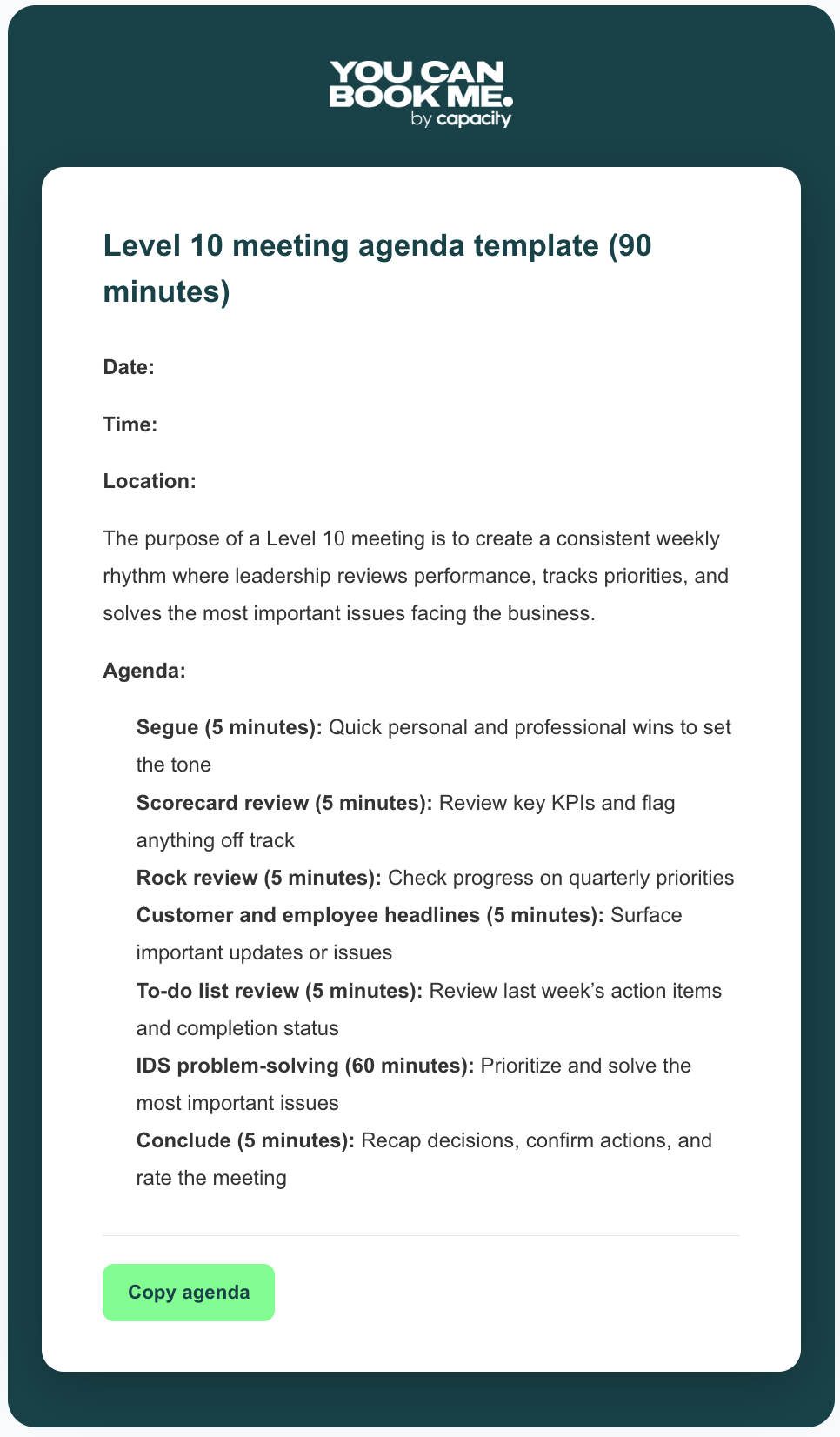
Level 10 meeting agenda template (90 minutes)
Date:
Time:
Location:
The purpose of a Level 10 meeting is to create a consistent weekly rhythm where leadership reviews performance, tracks priorities, and solves the most important issues facing the business.
Agenda:
- Segue (5 minutes): Quick personal and professional wins to set the tone
- Scorecard review (5 minutes): Review key KPIs and flag anything off track
- Rock review (5 minutes): Check progress on quarterly priorities
- Customer and employee headlines (5 minutes): Surface important updates or issues
- To-do list review (5 minutes): Review last week's action items and completion status
- IDS problem-solving (60 minutes): Prioritize and solve the most important issues
- Conclude (5 minutes): Recap decisions, confirm actions, and rate the meeting
🗣️ Best for: Leadership teams operating on EOS or those looking for a structured, repeatable cadence focused on accountability and issue resolution.
Another common way to structure a management meeting is around OKRs, or Objectives and Key Results, a goal-setting framework popularized by companies like Google.
At a high level, OKRs define what you want to achieve (objectives) and how you measure progress toward those goals (key results). When used in management meetings, they create a clear link between company priorities and day-to-day execution.
Instead of focusing primarily on issue-solving like EOS, OKR-based meetings are centered around tracking progress, identifying blockers, and making alignment decisions.
If you’re running your management meeting around OKRs, here is a simple agenda you can follow: 👇
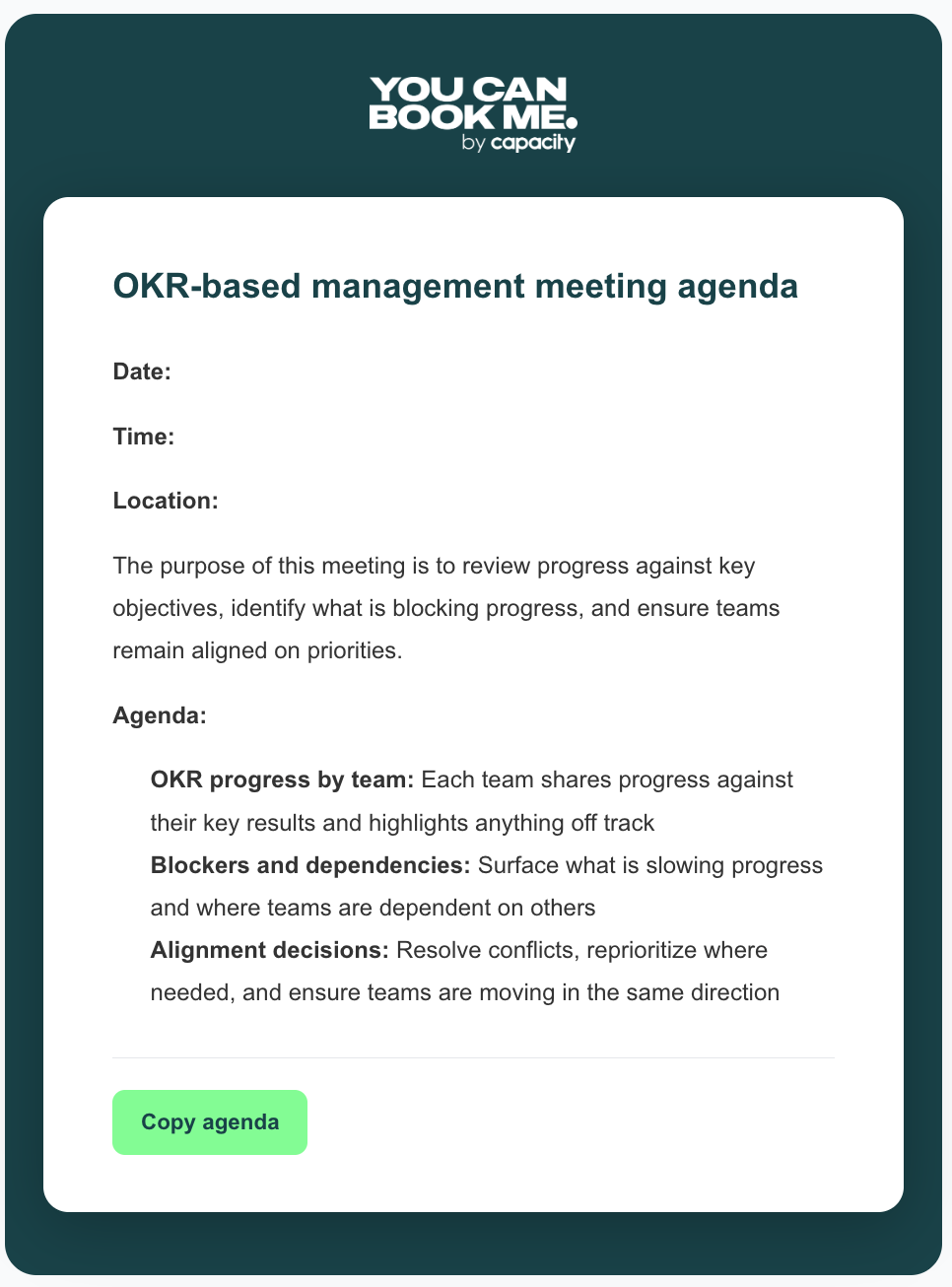
OKR-based management meeting agenda
Date:
Time:
Location:
The purpose of this meeting is to review progress against key objectives, identify what is blocking progress, and ensure teams remain aligned on priorities.
Agenda:
- OKR progress by team: Each team shares progress against their key results and highlights anything off track
- Blockers and dependencies: Surface what is slowing progress and where teams are dependent on others
- Alignment decisions: Resolve conflicts, reprioritize where needed, and ensure teams are moving in the same direction
🗣️ Best for: Teams operating with OKRs who want to stay closely aligned on goals, progress, and cross-functional dependencies.
If you don’t follow a specific framework like EOS or OKRs, a KPI-driven management meeting is a simple and effective alternative.
This format focuses on reviewing performance, tracking priorities, and creating space to solve the most important issues. It’s flexible, easy to implement, and works well for teams that want structure without committing to a formal system.
Here’s a simple agenda you can use: 👇
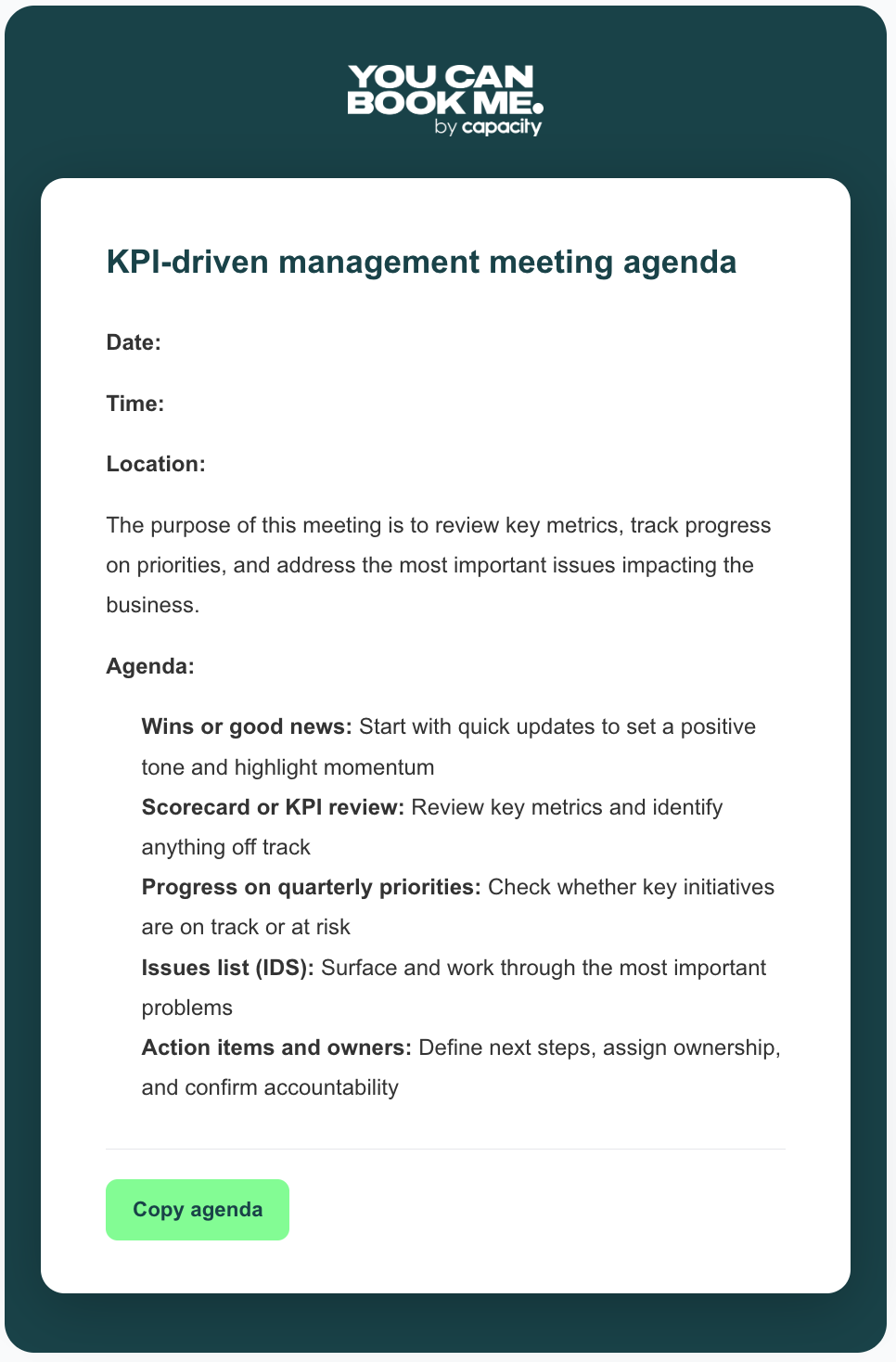
KPI-driven management meeting agenda
Date:
Time:
Location:
The purpose of this meeting is to review key metrics, track progress on priorities, and address the most important issues impacting the business.
Agenda:
- Wins or good news: Start with quick updates to set a positive tone and highlight momentum
- Scorecard or KPI review: Review key metrics and identify anything off track
- Progress on quarterly priorities: Check whether key initiatives are on track or at risk
- Issues list (IDS): Surface and work through the most important problems
- Action items and owners: Define next steps, assign ownership, and confirm accountability
🗣️ Best for: Teams that aren’t operating within a specific framework but still want a consistent, outcome-focused management meeting.
Alright, so you have a few different frameworks you can use to run your management meetings. Now let’s talk about what actually makes these meetings work in practice.
Because structure alone isn’t enough. The difference between a productive meeting and a frustrating one usually comes down to a handful of small habits, such as:
- Keeping the group small (5–9 people is ideal): A smaller group makes it easier to have focused, productive discussions. The people in the room should be those who own priorities and can make decisions. If the group gets too large, conversations slow down, accountability becomes less clear, and not everyone gets heard. In fact, 45% of workers say they feel unheard in meetings, which becomes more likely as group size increases.
- No laptops open unless you're note-taking: Laptops tend to pull attention away from the discussion, even when used with good intentions. Keeping them closed helps ensure everyone is engaged and present. If they’re needed, limit usage to note-taking or tracking action items.
- Protecting IDS time, as it’s the most valuable part of the meeting: The problem-solving portion of the meeting is where the real value is created. It’s easy for earlier sections to run long and eat into this time. Your teams should stay disciplined as much as possible and protect this block so issues actually get resolved.
- Separating updates from decisions in the agenda: Updates should be quick and focused on surfacing issues, not discussing them in depth. Decisions and problem-solving should happen in a dedicated section of the meeting.
- Rotating facilitation to build ownership across the team: Facilitating the meeting shouldn’t fall on one person every time. Rotating this role helps build shared ownership and keeps the team engaged in the process. It also brings different perspectives on how the meeting can be run effectively.
- Revisiting the format every quarter: What works today may not work three months from now as the business evolves. Take your time as a group to review and adjust the meeting structure to ensure it stays relevant.
Even with the right framework and best practices in place, management meetings can still go off track. In most cases, it isn’t because of a lack of effort. It’s because of a few common patterns that slowly reduce the effectiveness of the meeting over time. For example:
- Starting with a status update marathon: When the meeting begins with long updates, it immediately sets the wrong tone. Time gets consumed sharing information instead of solving problems. By the time you get to the important issues, there’s little time or energy left.
- Inviting too many people to avoid hurt feelings: It’s tempting to include more people to keep everyone informed, but this comes at a cost. Larger groups slow down discussions and make decision-making harder. The meeting should prioritize effectiveness over inclusivity.
- No agenda or a last-minute agenda: Without a clear plan, the meeting becomes reactive and unfocused. Conversations drift toward whatever feels most urgent in the moment. A consistent agenda ensures time is spent on what actually matters.
- Letting one or two voices dominate: When a few individuals control the conversation, valuable input is lost. Around 43% of employees say it’s hard to participate because a few voices dominate meetings. Strong meeting facilitation is key to making sure the right perspectives are heard.
- Walking away with no clear action items: If decisions aren’t tied to ownership and next steps, they rarely lead to execution. This creates a loop where the same topics are revisited in future meetings. Clarity on actions is what moves the business forward.
- Never addressing the same recurring issues: When the same problems show up week after week, it’s a sign they aren’t being properly solved. Teams may be discussing symptoms without getting to the root cause. Taking the time to fully resolve these issues is critical.
- Going in with the blame game instead of curiosity: If you start assigning fault, people become defensive and less open. This automatically limits honest discussion and slows down problem-solving. A focus on understanding leads to better decisions and stronger alignment.
The bottom line
At the end of the day, a management meeting is only valuable if it drives action.
Clear priorities, real decisions, and consistent follow-through are what separate effective team meetings from the rest. The frameworks and practices in this guide will give you a strong foundation, but how you run the meeting week after week is what matters most.
It’s also worth remembering that many meetings fail before they even start. Scheduling, coordination, and meeting preparation all play a role. And that’s exactly where YouCanBookMe can help. By simplifying how meetings are booked and organized, it helps you spend less time coordinating and more time leading effective discussions.
FAQs
What is the difference between a management meeting and a staff meeting?

A management meeting and a staff meeting serve very different purposes, even though both are recurring fixtures in most organizations. A management meeting is limited to senior leaders, such as executives, department heads, and directors, and focuses on strategy, cross-functional decision-making, and resolving issues that affect the broader business. The expected output is clear decisions, assigned priorities, and actionable next steps.
A staff meeting, by contrast, typically involves individual teams or departments and is centered around sharing updates, coordinating work, and maintaining day-to-day alignment. It is more informational than decisional.
How long should a management meeting be?
Most effective management meetings run between 60 and 90 minutes. The Level 10 Meeting format, for example, is designed as a 90-minute session. The key is to protect time for problem-solving rather than letting updates and check-ins consume the entire meeting. Shorter, more focused meetings tend to produce better outcomes than long, unstructured ones.
What topics should be discussed in a management meeting?
The most important topics for a management meeting include progress on quarterly priorities, key performance indicators, cross-functional blockers, and unresolved issues that require leadership input. The meeting should focus on what needs a decision or alignment, not on routine updates that could be shared asynchronously. Keeping the agenda tied to the most critical business challenges ensures time is spent where it matters most.

Written by
Paulina Major
Paulina Major is a freelance B2B content writer who has spent the last two years deep in the world of scheduling — writing about booking best practices, time management, and the tools that help small businesses run more efficiently. She writes from experience: as a solopreneur managing her own clients and calendar, she lives the challenges her readers are trying to solve.
Get started today
Join thousands of coaches, consultants, and entrepreneurs who use YouCanBookMe to power their business. Get your first booking in a few minutes.


 4.7 / 5 — Trustpilot

