
How to Create a Payment Policy for Your Small Business


Create your free booking page
Getting paid on time is crucial for small business success, but it doesn’t always happen automatically.
Whether you work with clients or vendors, a payment policy sets the ground rules. It outlines:
- When payment is due
- What payment methods you accept
- What happens if someone pays late
Having a payment policy in place helps you protect your cash flow and avoid awkward money conversations later. Nobody really wants to send a payment reminder email because a client is two weeks late on an invoice, right?
In this article, you’ll learn:
- What a payment policy is and why your business needs one
- Common payment terms and which are best for your situation
- Real examples of small business payment policies you can adapt
A payment policy is a short set of rules that explains how and when customers should pay you. It tells them what payment methods you accept, when the money is due, and what happens if they pay late.
For small business owners, having a payment policy, among other workplace policies, is essential. It helps ensure reliable cash flow, reduces the risk of late or missed payments, and provides a clear framework for handling payment-related disputes.
One of the most important parts of any payment policy is setting clear payment terms—let’s break those down next.
Payment terms explain when payment is due and under what conditions—so both you and your client are on the same page from the start. The most common types of payment terms are:
- Net 30: Payment is due within 30 days of the invoice date. This gives clients some flexibility while helping you maintain predictable cash flow.
- Net 15/net 45/net 60: Variations of net terms based on your working relationship. Shorter terms, like net 15, are often used by freelancers, while longer terms, like net 60, are more common within large organizations.
- Due on receipt: Payment is required immediately upon receipt of the invoice. This is typical for one-time services, in-person appointments, or retail-style businesses—think haircuts, groceries, etc.
- Upfront/advance payment: The client pays before any work begins—either the full amount or a deposit. It's a helpful approach when working with new clients or taking on custom projects.
- Milestone-based payments: Payment is split into stages tied to project progress (e.g., 30% at kickoff, 40% mid-project, 30% on completion). This keeps cash flowing steadily during longer or more complex projects.
- Monthly retainer: A fixed amount is billed on a recurring schedule, usually monthly. This model works well when providing ongoing services or support.
Different types of businesses tend to use different payment terms based on the kind of work they do and how they bill clients. Here’s a quick breakdown you can use for reference. 👇
|
Context |
Typical terms |
|
Freelancers/consultants |
Net 15 or upfront |
|
Agencies |
Net 30 |
|
Enterprise clients |
Net 45–60 |
|
SaaS |
Monthly or annual upfront |
|
New client |
Upfront or net 15 |
|
Long project |
Milestone-based |
That covers the theory! Now let’s bring it to life with some real-world examples. Seeing how other small businesses structure their payment policies can help you decide what to include in yours (and what to leave out).
Every business has its own way of handling payments—and your policy should reflect the type of work you do, the clients you serve, and how you prefer to get paid. To help you get started, we’ve gathered a few real-world examples from different industries.
The first example we’re looking at comes straight from my own business!
As a freelance content writer working with clients on a contract basis, I share a welcome package with every new client—a Google Doc that outlines key details, like project turnaround times, rates, and, of course, my payment policy.
You don’t necessarily need to create a full welcome pack. Your payment policy can also live in your client contract or on your website—anywhere that makes it easy for clients to see and understand before work begins.
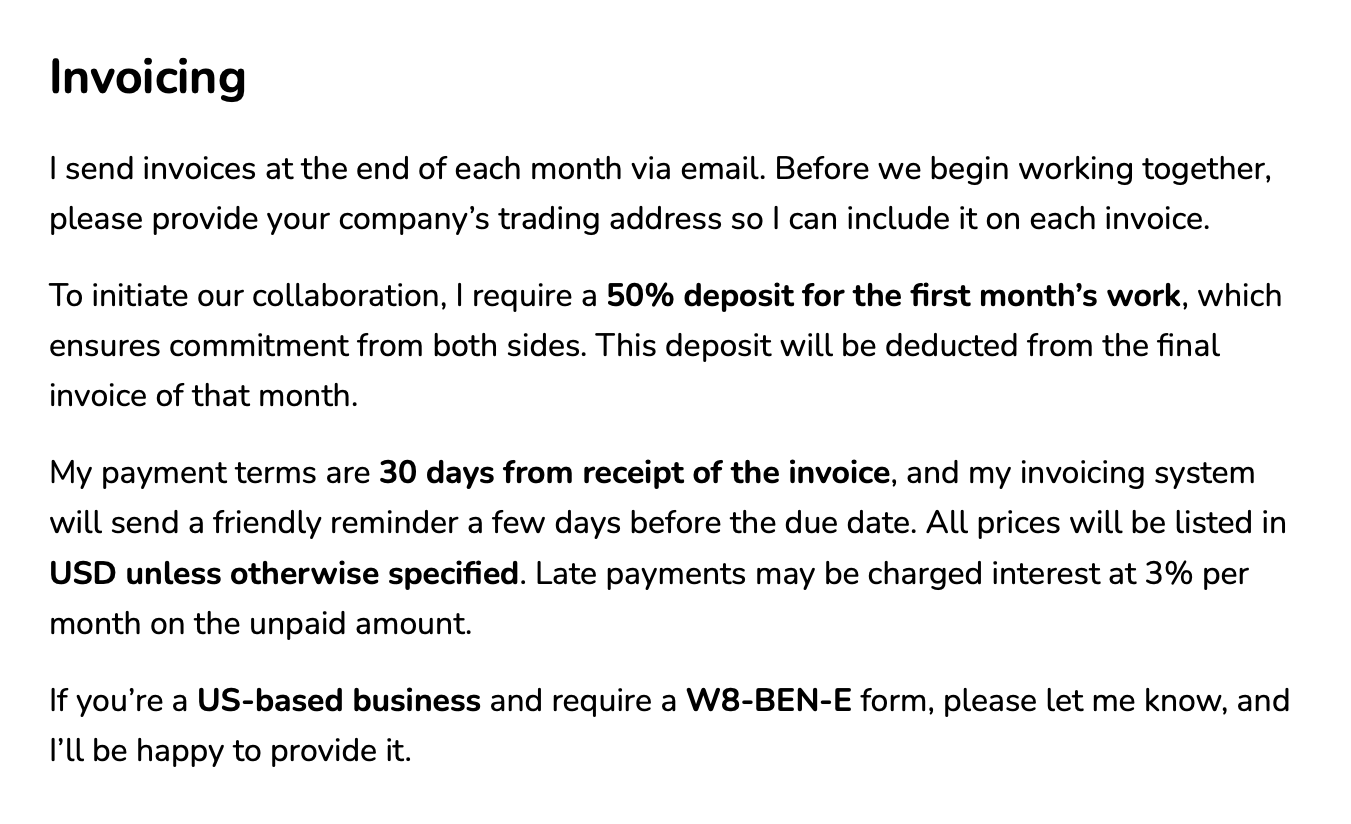
Here’s how I structure my payment policy:
- To start working together, I require a 50% deposit for the first month’s work. This ensures commitment on both sides and is applied toward that month’s final invoice.
- My standard payment terms are 30 days from receipt of the invoice (net 30), and I send a friendly reminder a few days before the due date.
- All pricing is listed in USD (unless otherwise agreed) and late payments may incur a 3% monthly interest charge.
|
💰 As a consultant, you might also need to know how to communicate price increases to your client. Check out our guide on how to write a price increase notification for practical tips and email templates. |
This next example comes from SKA Thermal Spa, a wellness center that outlines their payment process directly in the FAQ on their website.
Here’s how they explain it:
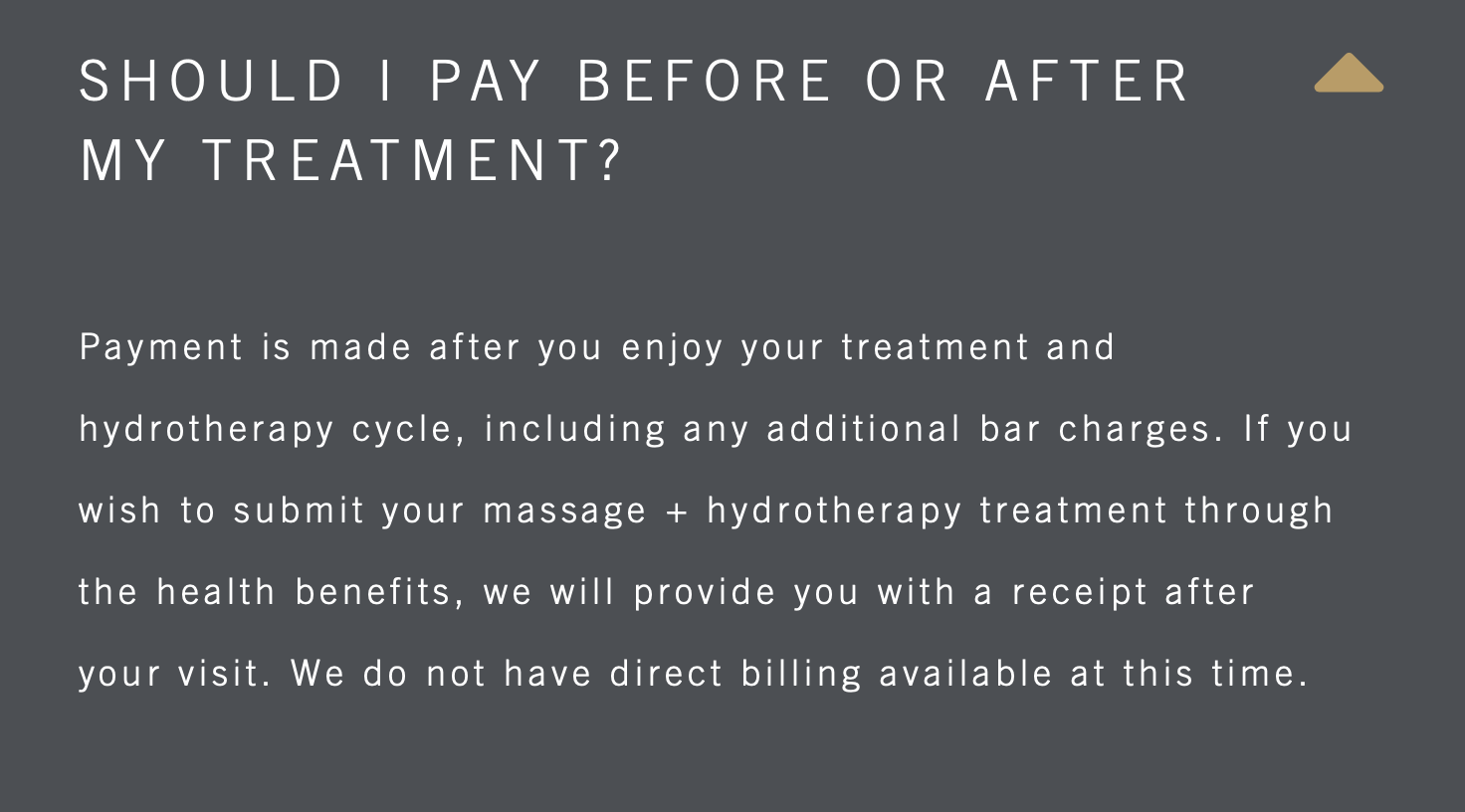
Here’s what we like about their payment policy:
- It clearly explains when payment is due (after the service), removing any uncertainty.
- It accounts for special cases like health insurance reimbursements, which can be a common client question.
- It manages expectations about what the spa does not offer (in this case, direct billing), so there are no surprises.
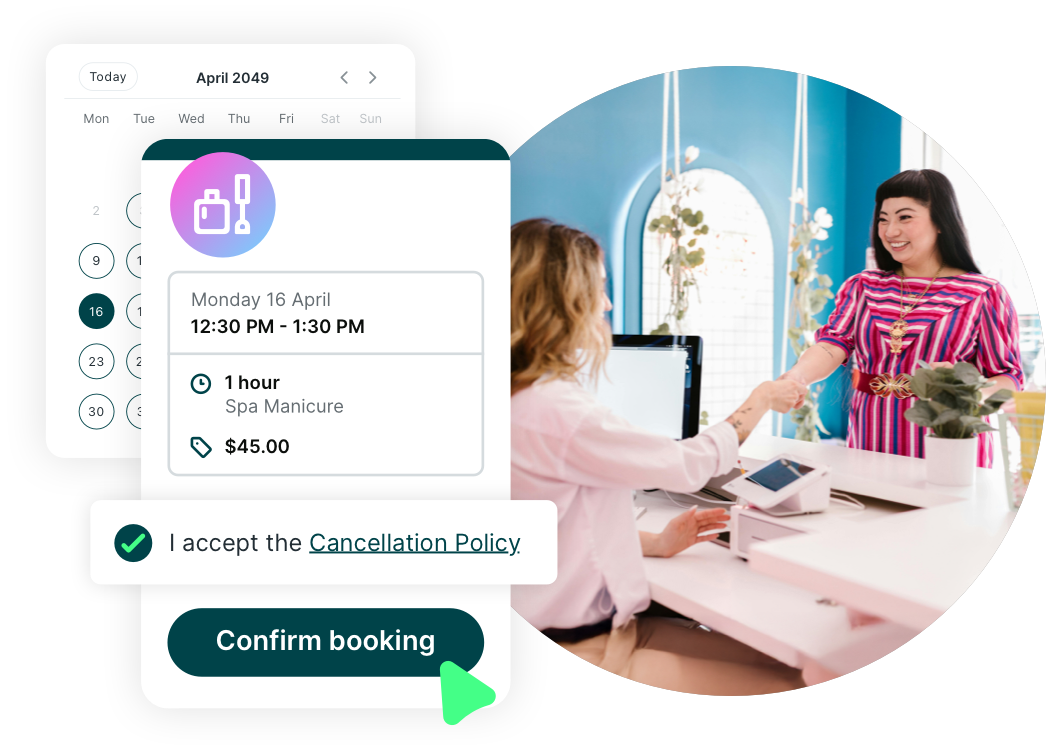
As a salon or spa business, your website FAQ isn’t the only place you can include your payment policy. You can also share it on your booking page, inside appointment confirmation emails, and in a reminder message sent ahead of the appointment. Displaying your policy in multiple touchpoints helps set expectations early and reduces awkward conversations at checkout.
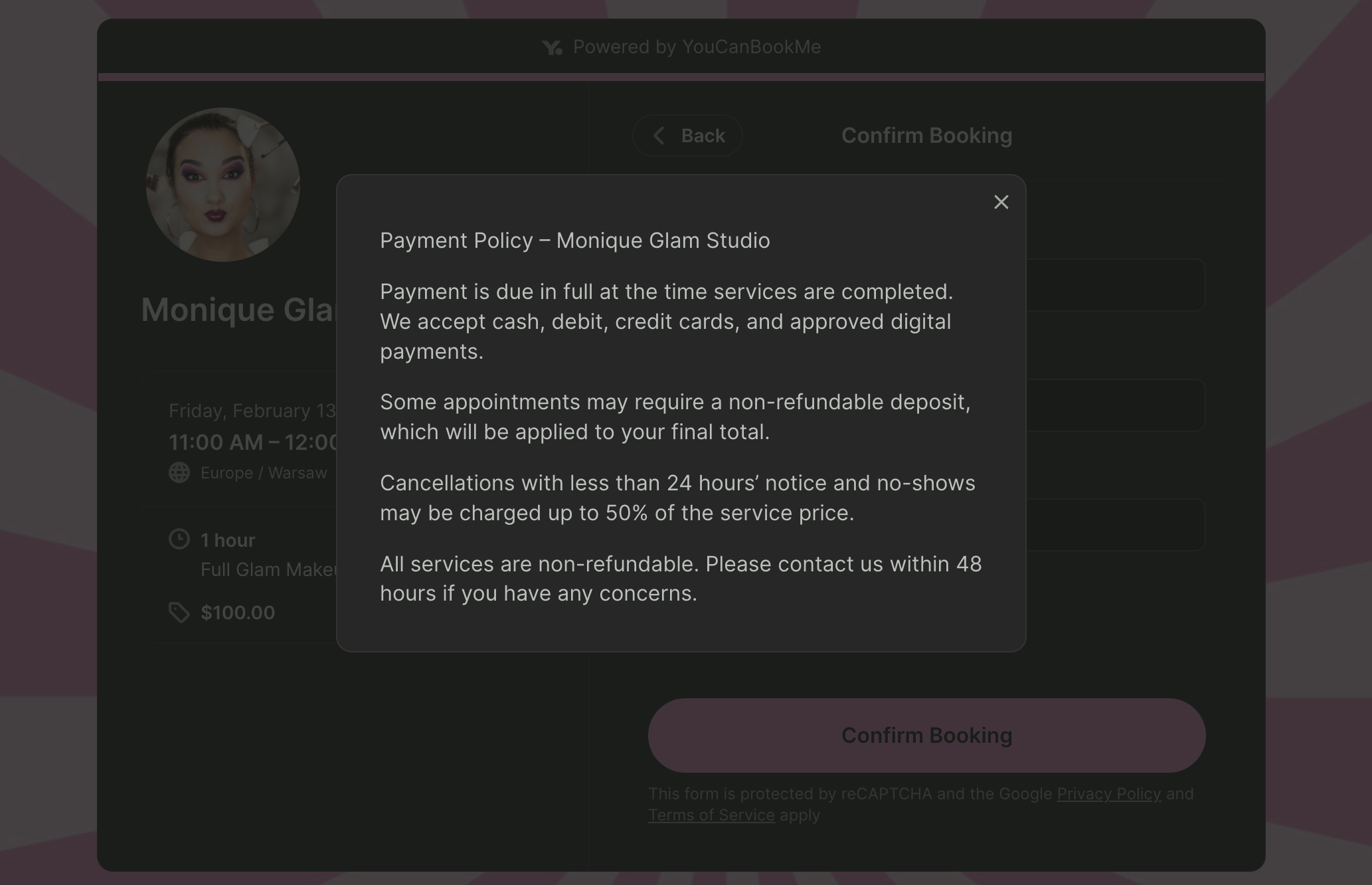
If you use a scheduling app, this becomes even easier to manage. For example, with YouCanBookMe (YCBM), you can display your payment policy directly on your booking page and automatically include it in confirmation and reminder emails. In addition, YCBM allows you to:
- Take full or partial payments at the time of booking
- Customize your booking page with multiple services or add-ons
- Add buffer time between appointments
- Reduce no-shows with automated reminders and confirmations
Your booking page, your policy, your rules
Easily add your payment policy to your booking page and confirmation emails. With YCBM, your clients always know what to expect before they walk in the door.

For online marketplaces and platforms, payment policies are often more complex—and strictly enforced. Take eBay, for example, which maintains a detailed payment methods policy that outlines which payment options are allowed, and which are not.
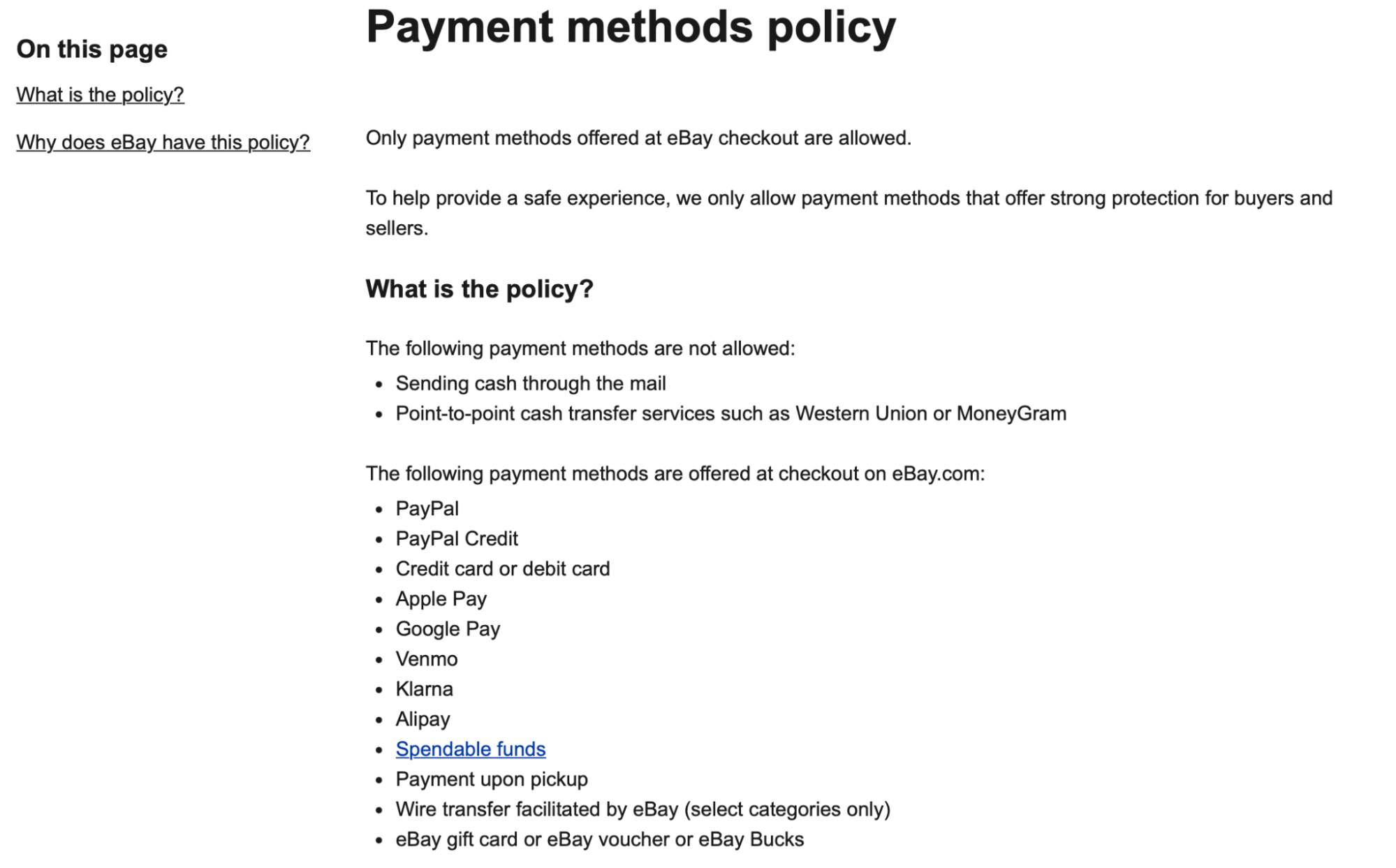
Here’s a quick summary of their policy highlights:
- Buyers must use one of the approved methods at checkout, such as PayPal, credit/debit cards, Apple Pay, Google Pay, Venmo, Klarna, or eBay gift cards.
- eBay explicitly prohibits risky payment methods, like sending cash by mail or using point-to-point services like Western Union.
- Available payment methods may vary depending on category, item price, buyer location, and device.
- Contact information between buyer and seller can only be exchanged after checkout, as part of their buyer protection system.
|
💡 Pro tip: If you're running an e-commerce business, it makes sense to include your payment policy in your knowledge base. Customers often visit it when they have questions about payments, shipping, or returns, so it’s a natural place to clarify accepted methods, processing times, and any exceptions. |
If anyone knows how to write terms and conditions, it’s a law firm. Hassett & George, P.C. offers a detailed payment policy on their website that covers how clients are billed, when payments are due, and how disputes are handled. It’s a great example of what professional service businesses should aim for, especially when billing is hourly, ongoing, or tied to case outcomes.
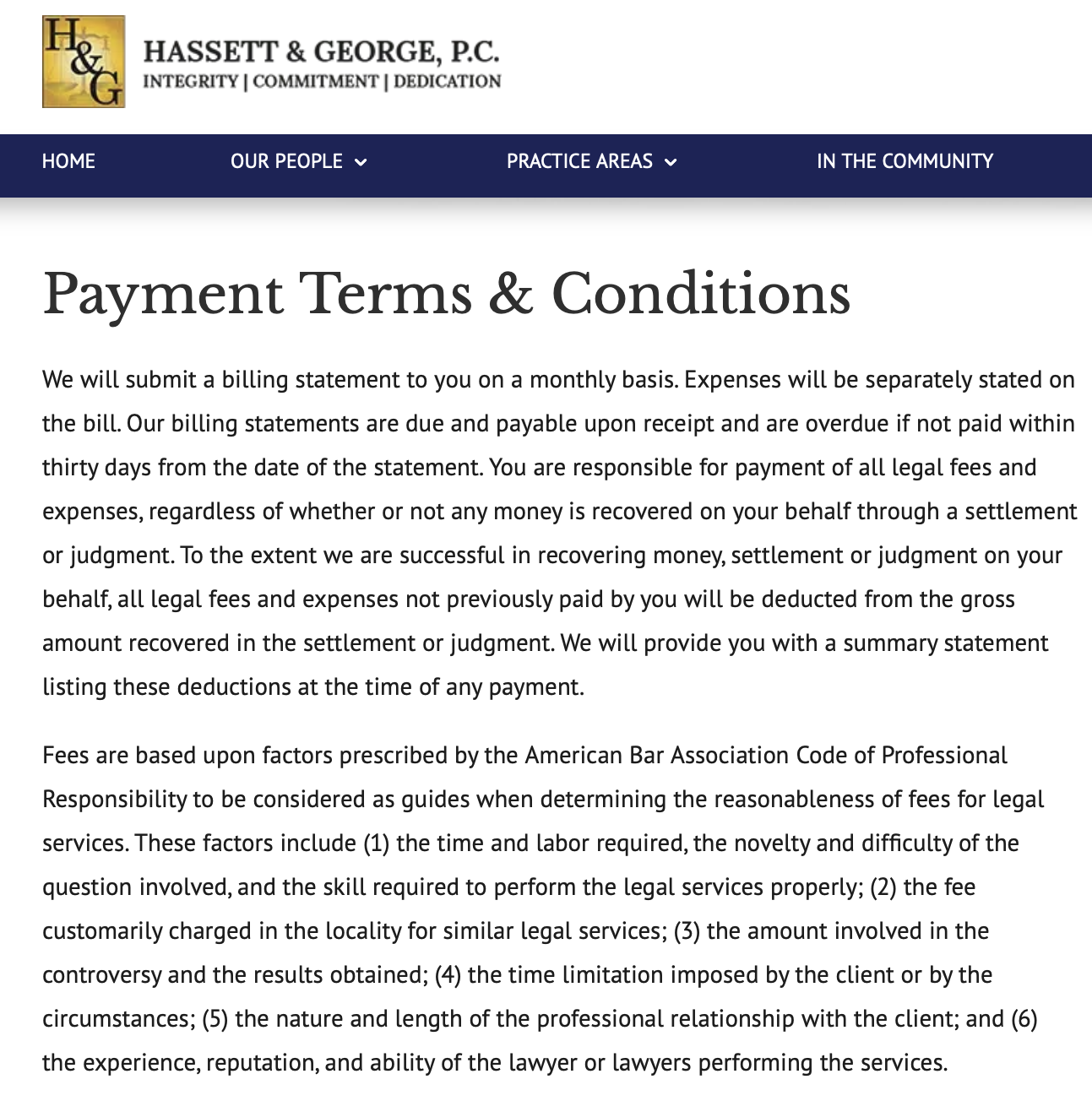
Here’s what we like about their payment policy:
- It sets clear expectations for billing frequency and payment due dates. Clients are invoiced monthly, and payment is due upon receipt, but considered overdue after 30 days.
- It explains how legal fees are calculated, referencing ABA standards to add transparency and structure.
- It includes a process for billing disputes, encouraging clients to raise concerns within 30 days so issues can be resolved while they’re still fresh.
Make scheduling easier for your clients
With YouCanBookMe, your law firm can offer a seamless scheduling experience that matches the professionalism of your practice. It’s easy to set up, customizable, and built for client-facing work.
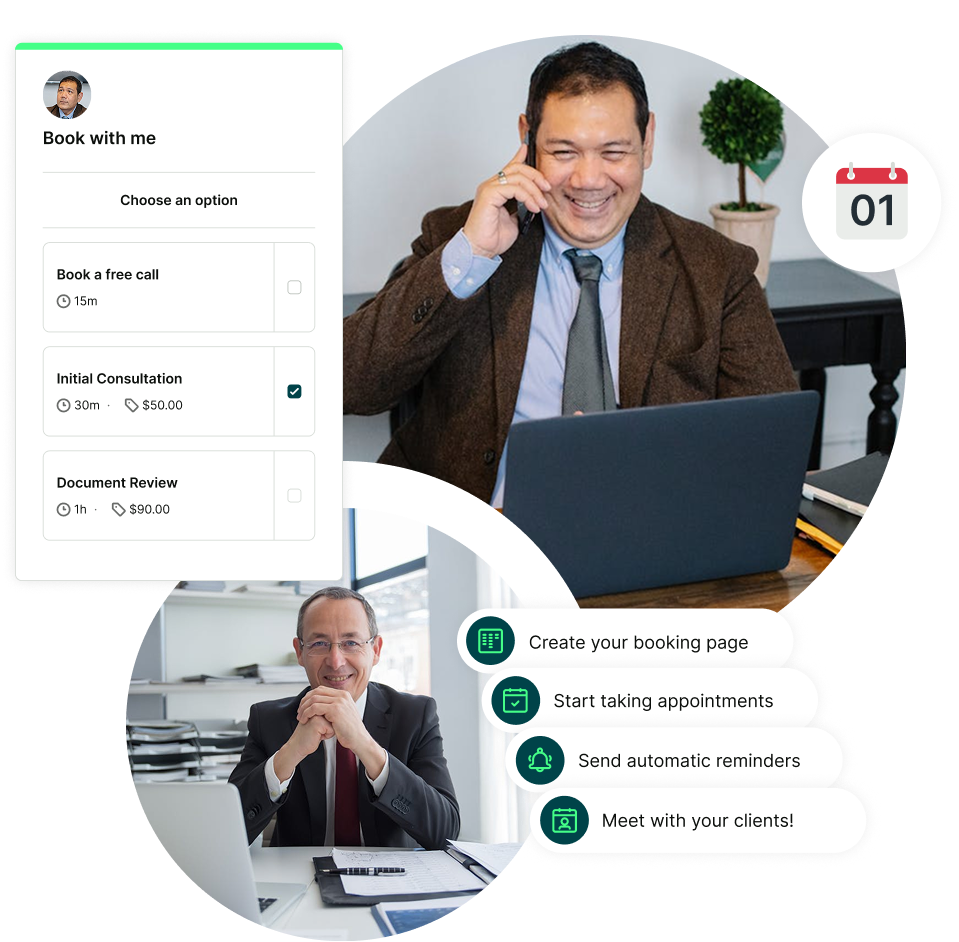
I think the biggest feature that has been useful for us is the automated reminders and follow-ups. We feel comfortable knowing that we're doing our part to make sure that clients are staying engaged with us."
– Scott & Stephanie Learned, Founders of Learned Lawyers
The bottom line
Getting paid shouldn’t be stressful. With the right payment policy in place, you can set expectations early and focus on the work you actually enjoy, which, I’m sure, isn't chasing unpaid invoices.
If you want to streamline scheduling too, YouCanBookMe can help. It lets clients book time with you easily and gives you the opportunity to communicate your payment terms directly on your booking page, as well as in confirmation and reminder messages.
FAQs
What’s the difference between milestone payments and upfront payments?

Upfront payments require the client to pay all or part of the total before work begins—great for new clients or smaller, one-off projects. Milestone payments, on the other hand, break the total into scheduled portions based on project progress (e.g., 30% at kickoff, 40% mid-project, 30% on delivery). Milestone billing works well for longer or more complex projects where you're delivering in phases.
How do I make a payment policy for my business?
Start by outlining the key details you want clients to know about how and when to pay you. Keep it short, clear, and easy to understand. A good payment policy typically includes:
- When payment is due (e.g., upfront, Net 30, due on receipt)
- Accepted payment methods (credit card, bank transfer, Stripe, etc.)
- Late payment terms (grace periods, late fees, or interest charges)
- Refund or cancellation terms, if applicable
Once written, include your payment policy wherever it makes sense, like in contracts, on invoices, your website, or in booking confirmation emails.
What are the best payment methods for small businesses?
The best payment method depends on what’s most cost-effective for your business and what’s easiest for your clients. Here are some common options small businesses use:
- Direct deposit (ACH) – Low or no fees, but less convenient for some clients
- Credit/debit cards – Widely used, but come with processing fees
- Stripe – Great for online payments and recurring billing; includes transaction fees
- PayPal – Convenient for many customers; fees apply
- Apple Pay / Google Pay – Fast and mobile-friendly
- Cash or checks – Useful for in-person payments, but harder to track
- Buy Now, Pay Later services (e.g., Klarna, Afterpay) – Good for product-based businesses
If you’re using a scheduling tool like YouCanBookMe, you can collect payments or deposits through Stripe at the time of booking, meaning you’re covered before any work even begins.

Written by
Paulina Major
Paulina Major is a freelance B2B content writer who has spent the last two years deep in the world of scheduling — writing about booking best practices, time management, and the tools that help small businesses run more efficiently. She writes from experience: as a solopreneur managing her own clients and calendar, she lives the challenges her readers are trying to solve.
Get started today
Join thousands of coaches, consultants, and entrepreneurs who use YouCanBookMe to power their business. Get your first booking in a few minutes.


 4.7 / 5 — Trustpilot

