
Check-in Meeting Guide: Agendas, Questions, and Best Practices


Create your free booking page
Most teams already have some form of a check-in meeting, even if they don’t call it that. It might be a quick standup, a weekly team sync, or a one-on-one meeting between a manager and an employee. But are they actually doing anything useful?
Without a clear purpose or structure, check-in meetings can turn into repetitive status updates that don’t improve performance or alignment. But if you approach them the right way, they become a simple way to surface blockers, share feedback, and keep work moving.
In this blog post, we’ll tell you everything you need to know about running productive check-in meetings—from the types of meetings that exist to how to structure them using practical agendas and best practices.
A check-in meeting is a recurring business meeting used to review progress, confirm priorities, and identify risks, blockers, or support needs. It helps managers and teams stay aligned, monitor performance, and make timely adjustments to ongoing work.
Check-in meetings are not meant for deep problem-solving or long discussions. Instead, they focus on current status, near-term goals, and next steps.
Common types of check-in meetings include:
- Manager-employee one-on-ones: Used to review performance, goals, feedback, and development needs.
- Standups: Brief, recurring meetings to share progress, upcoming work, and blockers.
- Team syncs: Regular team meetings to align on priorities, coordinate efforts, and address issues impacting delivery.
While formats may differ, every check-in meeting serves a few core business purposes. These are:
- Status updates: Provides a reliable way for teams to give updates on the work they’re doing and to hear what other colleagues are working on.
- Feedback & support: Creates space to give timely feedback, flag concerns, and ask for help.
- Team alignment: Ensure everyone is working toward the same priorities. They clarify expectations, timelines, and ownership so teams stay coordinated.
- Employee engagement: Creates space for people to feel heard, supported, and involved in their work.
Check-in meetings work best when you put some effort into organizing them. Here are the best methods to help you run these meetings:
A meeting agenda defines the purpose of the check-in meeting and sets expectations for what will be discussed. Sharing it in advance gives participants time to prepare meaningful updates instead of reacting in real time.
For example, a weekly team sync agenda might include priority updates, blockers, and upcoming deadlines, while a one-on-one agenda may focus on progress toward goals and support needs.
P.S. If you don’t want to start from scratch, we’ve included a few free agenda templates later in this article that you can grab and reuse!
Don’t come unprepared. Remember, the goal is to run a productive meeting—not a casual status update on what everyone did Friday evening or where somebody ate pizza on Saturday night.
Preparation could look something like this: reviewing progress since the last check-in, noting any blockers or risks, and thinking through what support or decisions are needed next. If you’re a manager having a one-on-one with an employee, you should also revisit prior notes or follow up on open action items.
At the same time, everyone attending the meeting should come prepared too. That means showing up ready to share concise updates, raise issues that need attention, and contribute to next steps.
Check-in meetings only work when people feel comfortable speaking up and know they’ll have the chance to contribute. That’s why you should create space for open communication by setting clear norms around participation. This can be as simple as encouraging concise updates, asking direct follow-up questions, or explicitly inviting input from quieter team members.
Structured approaches can also help. For example, a round-robin format—where each person has a short, dedicated turn to speak—ensures everyone is heard without the conversation drifting or becoming unbalanced. This is especially useful in team check-ins or standups.
Yes, this is standard meeting protocol. But even for more casual check-in meetings, you should still take notes and track action items.
Taking notes doesn’t mean transcribing the entire meeting (though you can do that too—just delegate it to an AI meeting note-taker). It simply means capturing what matters and turning it into clear meeting minutes the team can reference later:
- Key updates
- Decisions and task owners
- What needs to happen next
Without that record, teams end up rehashing the same topics week after week or wondering why something never got done. One simple way to make meeting minutes more effective? Recap each agenda item as you go!
In the video below👇, Hiba Amin from Hypercontext shares how summarizing discussions in real time helps confirm shared understanding and gives everyone a chance to say, “Yes, that’s what I heard too.”
Action items are especially important. If something needs follow-up, assign a clear owner and be specific about what “done” looks like. Otherwise, it’s just a well-intentioned idea floating between meetings.
Don’t end your check-in meeting with “okay, sounds good—see you next week!” Before wrapping up, take a moment to summarize what was discussed, what decisions were made, and what the next steps are.
You only need a quick recap, so your team leaves with alignment and clear responsibilities before the next check-in.
It’s also a good practice to hold your check-in meeting at the same time and cadence whenever possible. It’s hard for people to fit in unexpected check-ins scheduled on the fly. Instead, add the meeting as a recurring event on everyone’s calendar and stick to it. This consistency also supports better time management, since everyone can plan their work around a predictable schedule.
Time-boxing the meeting is just as important. Set a clear start and end time, and stick to it. This keeps the meeting focused and prevents it from running longer than needed.
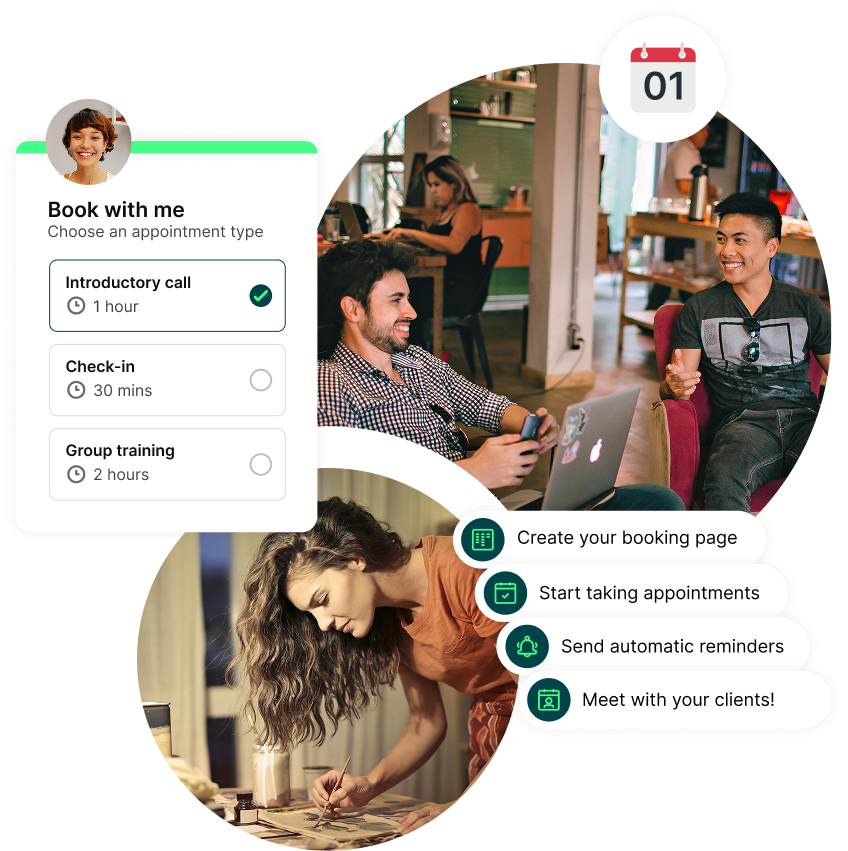
One of the easiest ways to keep check-in meetings consistent is to schedule them using a dedicated scheduling tool. Manually coordinating times or sending reminders each week adds unnecessary friction and makes meetings easier to skip or forget.
A scheduling tool makes it easier to find a meeting time that fits everyone’s schedules and removes unnecessary back-and-forth, especially since you can easily check the pooled availability of all your team members
Tools like YouCanBookMe (YCBM) are designed to handle this behind the scenes. With built-in time zone support, teams can schedule check-ins confidently across locations. Automated meeting confirmations and reminders, and easy rescheduling help keep meetings organized as schedules change.
When scheduling is handled for you, it’s easier to focus on the conversation itself—not the logistics.
Simplify check-in meeting scheduling
If you’re ready to spend less time coordinating calendars and more time having productive check-ins, YouCanBookMe makes it easy to get started.

Last but not least, it’s a good idea to occasionally ask for feedback on the check-in meetings themselves. Not at every single meeting, but from time to time, invite the team to share what’s been helpful, what could be improved, and whether the format, frequency, or length is still working.
This helps ensure the check-ins stay useful, relevant, and comfortable for everyone because nobody needs a useless meeting in their schedule.
Having a standard meeting agenda at hand makes meeting prep super easy. Here are three check-in meeting agenda templates for different scenarios.👇
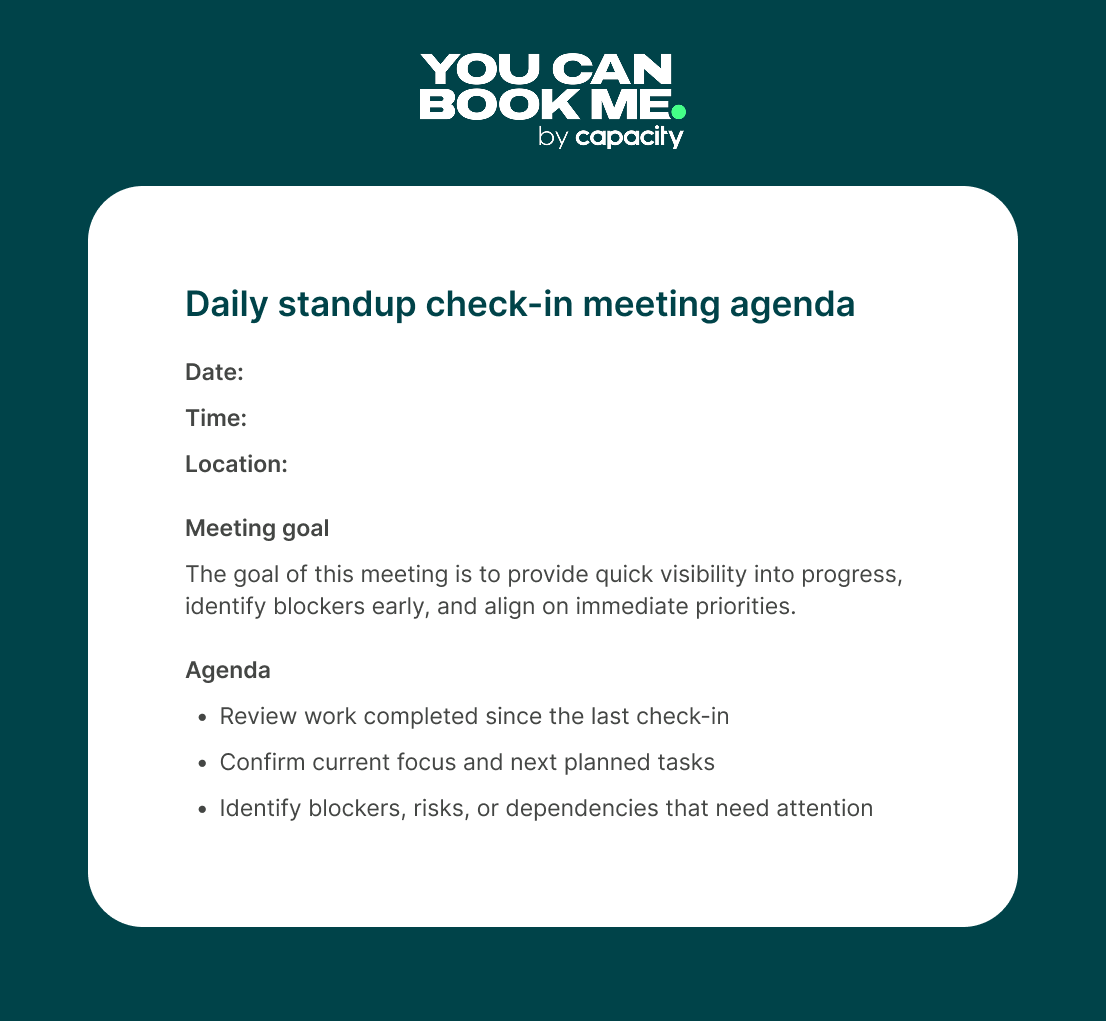
This is typically a daily 10–15 minute sync where team members take turns answering three questions:
- What did I do yesterday?
- What will I do today?
- Are there any blockers?
The meeting should be short and focused, helping the team align on daily goals and surface any immediate or longer-term blockers, especially those that require support from others to resolve.
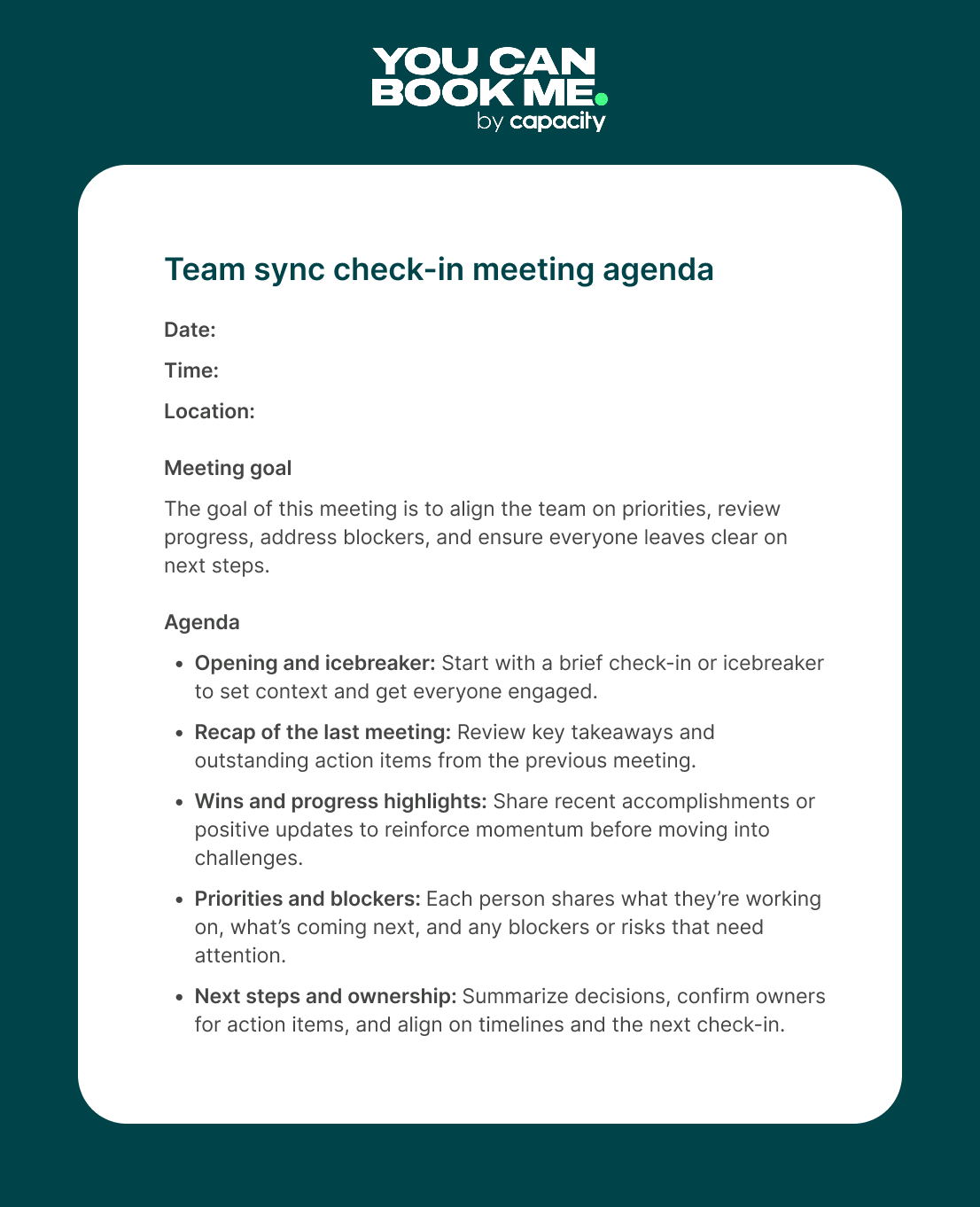
This is typically a 30–60 minute meeting. The agenda can be flexible, especially if team members or managers want to add new items. However, a good standard agenda to build from includes:
|
💡 Pro tip: If you need to coordinate a specific project with only certain team members, keep that discussion out of your regular team sync. Use a dedicated coordination meeting instead, so your check-in stays focused and relevant for everyone. |
Manager–employee one-on-one check-ins are typically held as a recurring 30-minute meeting. They provide dedicated time to review progress, discuss performance, address challenges, and support an employee’s growth. Unlike team meetings, 1:1s create space for more open conversation, ongoing coaching, and two-way feedback.
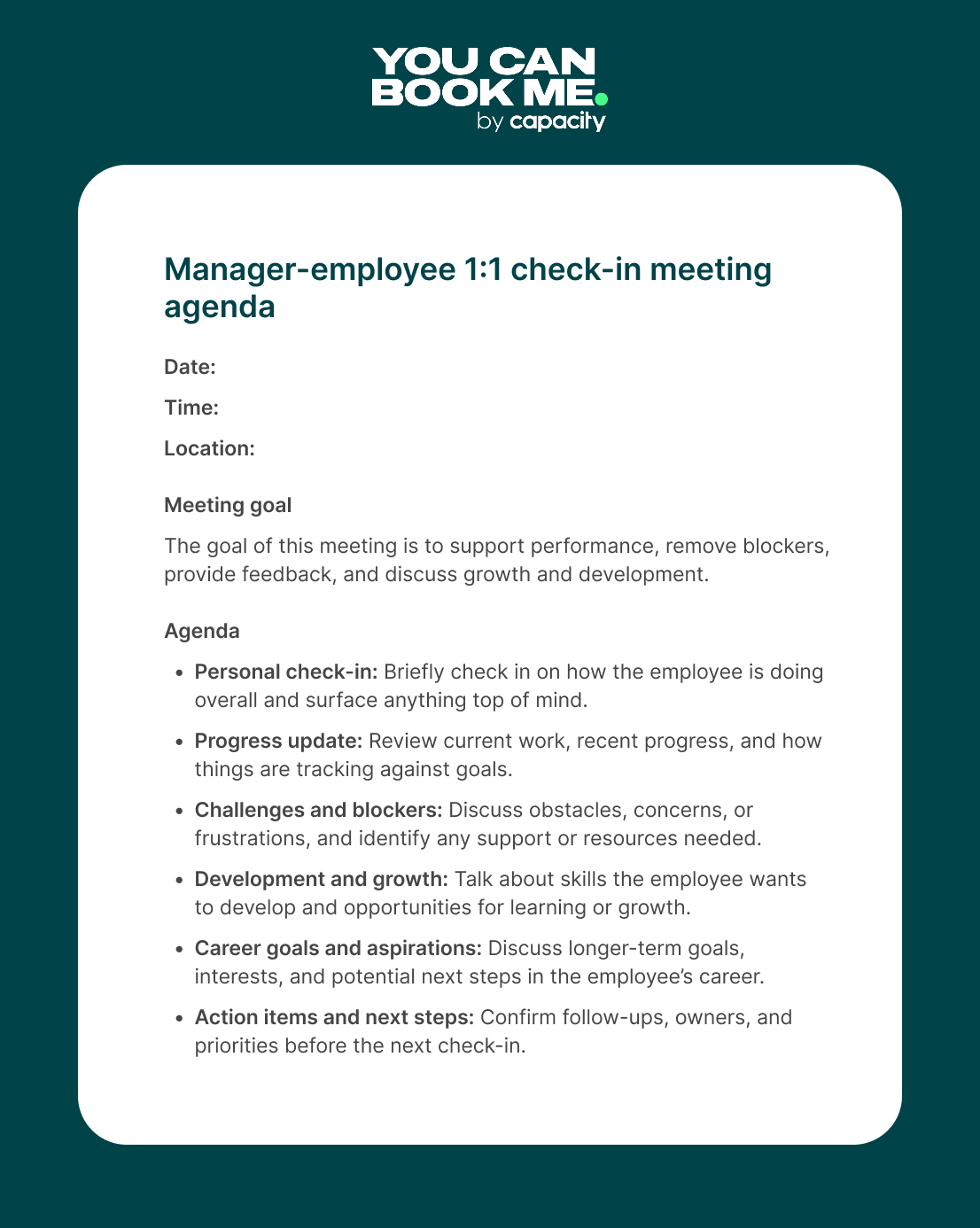
Once the structure and agenda are set, the next step is making sure you ask the right questions. In the next section, we’ll share practical check-in questions to ask, organized by purpose, that you can use across different types of check-ins.
Check-in questions help guide the conversation and keep meetings focused on what’s relevant right now. The right questions make it easier for people to share progress, raise concerns, and ask for support without turning the meeting into a long status update.
If you want to understand what your team is working on and what their real priorities are, you need to ask direct, practical questions. These prompts help surface current work, upcoming focus areas, and whether anything needs attention.
- What did you accomplish this week that you’re most proud of?
- What are you working on right now?
- What’s your top priority for next week?
- Is anything taking longer than expected? Why?
- What projects or tasks are you most excited about?
- Are there any deadlines coming up I should know about?
- What’s one thing you completed that moved the needle forward?
- How is [specific project] progressing?
- What are you planning to focus on after you finish [current task]?
- Is your workload manageable right now?
If you want to understand what’s getting in the way of progress, you need to ask questions that make it easy for people to speak up. These questions focus on obstacles, friction, and the kind of support that would help work move faster or more smoothly.
- What’s blocking you or slowing you down right now?
- What’s the biggest challenge you’re facing this week?
- Is there anything I can do to make your job easier?
- What resources or information do you need that you don’t have?
- Are there any decisions you’re waiting on from me or others?
- What’s something you’re struggling with that we could problem-solve together?
- Is there anyone else on the team you need more support or collaboration from?
- What processes or tools are making your work harder than it needs to be?
- What would help you be more productive or effective?
- Is there anything unclear about expectations or priorities?
Check-in meetings shouldn’t be only about tasks and deadlines. They can also create space to understand how people are feeling, how sustainable their workload is, and whether anything is affecting morale.
These questions work best in one-on-ones or smaller settings, and only when there’s enough trust to support honest answers. Use them selectively and with context.
- How are you feeling about work overall right now?
- On a scale of 1–10, what’s your energy level this week?
- Are you feeling overwhelmed, underwhelmed, or about right with your workload?
- What’s been the most stressful part of your week?
- How’s your work-life balance feeling lately?
- Is there anything about the team dynamic or culture that’s bothering you?
- What’s been the highlight of your week?
- Do you feel like you have enough time to disconnect and recharge?
- Is there anything making work less enjoyable than it could be?
- How are you doing outside of work? (only if appropriate for your relationship)
- What’s on your mind this week?
Looking for more inspiration for your 1:1s? Check out the video below, where Jordan Hirsch shares the questions you should add to your next 1:1 meeting agenda 👇
Growth and development questions focus on learning, skill-building, and longer-term goals. They’re best suited for manager–employee one-on-one check-ins, where there’s time to step back from day-to-day tasks and talk about what someone wants to grow into next.
- What skills are you hoping to develop or improve?
- What type of work would you like to do more of?
- Is there a project or responsibility you’d like to take on?
- What’s something new you’ve learned recently?
- Where do you see yourself growing in the next 6–12 months?
- Is there any training or learning opportunity you’re interested in?
- What kind of feedback would be most helpful for you right now?
- Are there any skills you feel like you’re not getting to use enough?
- What aspects of your role do you find most fulfilling?
- Is there someone on the team or in the company you’d like to learn from or shadow?
An easy way to schedule check-in meetings
Running regular check-in meetings is paramount for any team that wants to stay aligned, catch issues early, and support people effectively. We hope the agenda templates, best practices, and questions in this guide help you feel better prepared to run them with confidence.
To make those check-ins sustainable, scheduling them should be as easy as ABC. When coordinating calendars takes too much time, meetings are more likely to be delayed, missed, or dropped altogether.
YouCanBookMe for teams helps remove that friction. With built-in time zone support, teams can schedule check-ins confidently across locations. Meanwhile, automatic meeting confirmations and reminders help make sure your team doesn't miss these check-ins when things get hectic.
FAQs
How long should a check-in meeting be?

Most check-in meetings fall somewhere between 15 and 30 minutes, depending on the format. Daily standups or quick team check-ins usually work best at around 15 minutes. Manager–employee 1:1s often need closer to 30 minutes to cover progress, challenges, and development without feeling rushed.
If meetings consistently run long, it’s usually a sign that the scope is too broad—or that some topics should be handled outside the check-in.
How often should we have check-in meetings?
There’s no single “right” cadence. Daily check-ins work well for fast-moving teams or active projects. Weekly check-ins are common for 1:1s and team syncs. Bi-weekly check-ins can be enough for more independent teams or slower-moving work.
What matters most is consistency. Pick a cadence that fits your team’s pace and stick with it long enough to build a habit.
What’s the difference between a check-in meeting and a status update?
A status update is usually one-way and focused on reporting what’s been done. A check-in meeting is more conversational. It’s a chance to talk through progress, surface blockers, ask questions, and offer support.
Many status updates can happen asynchronously in work tools like email or Slack. Check-ins are better used for real-time discussion.
What if there’s nothing to report in a check-in meeting?
If there truly aren’t any updates or issues to discuss, it’s okay to end the meeting early—or occasionally skip it. That’s better than forcing a conversation that doesn’t add value.
If this happens often, though, it may be a sign that the meeting is too frequent, too focused on status updates, or unclear in purpose. Use it as a signal to adjust the format, questions, or cadence rather than pushing through out of habit.

Written by
Paulina Major
Paulina Major is a freelance B2B content writer with six years of experience. Since 2024, she has written 100+ articles on scheduling and personally tested and reviewed 30+ booking tools, helping small business owners choose software and simplify their booking processes. As a solopreneur managing her own clients and calendar, she brings firsthand experience to her advice on scheduling, time management, and running a business.
Get started today
Join thousands of coaches, consultants, and entrepreneurs who use YouCanBookMe to power their business. Get your first booking in a few minutes.


 4.7 / 5 — Trustpilot

