
Meeting Cadence: How to Set the Right Rhythm for Your Team


Create your free booking page
Most teams sit somewhere on a spectrum between two failure modes:
- Too many meetings that fragment the day and leave no time for actual work
- Not enough meetings that let misalignment quietly build until something goes wrong.
Finding the right meeting cadence is how you avoid both.
According to Atlassian, 78% of people say they attend so many meetings that it's hard to get their real work done. The problem usually isn't meetings themselves—or even the ability to run a meeting well. It’s how frequently these meetings are happening.
In this article, we’ll give you a clear framework for choosing, setting, and maintaining the right meeting rhythm for your team, without defaulting to meeting fatigue or information silos.
A meeting cadence is the regular, predictable schedule of recurring meetings a team commits to. It usually covers things like how often your team meets, when, and for how long. Unlike a one-off meeting called for a specific reason, a cadence is a pattern: a deliberate structure that repeats over days, weeks, or quarters.
These terms are often used interchangeably, but there’s a useful distinction. Frequency refers to how often meetings happen, like twice a week or once a month.
Meanwhile, cadence is the broader rhythm: frequency plus timing plus duration, working together as a system. You can have the right frequency and still have a broken cadence if meetings land at the wrong time or run too long.
Not every team needs the same meetings at the same intervals. Here is a breakdown of the main cadence types, with guidance on when each one fits: 👇
Let’s quickly go over each cadence type in a bit more detail. 👇
Best for: Agile teams, sprint-based work, and fast-moving projects where priorities or blockers change quickly.
Daily standups (typically 15 minutes) work well for teams moving fast on a shared project. The format is simple:
- What did you do yesterday?
- What are you doing today?
- What’s blocking you?
Scrum teams rely on this structure to keep sprints on track. Outside of sprint environments, a daily cadence can feel excessive for teams whose work changes slowly—so use it when pace genuinely demands it.
Best for: Most operational teams, regular team syncs, and 1:1s where ongoing alignment matters.
The weekly meeting is the workhorse of most team rhythms. A 30- to 60-minute sync gives enough time between meetings for meaningful progress, while keeping the team aligned on priorities and blockers. Most operational teams land here by default—and it is often the right call.
For 1:1 meetings, weekly is standard for new hires, anyone navigating a challenging project, or roles where the work is moving quickly. For experienced team members in a steady rhythm, bi-weekly can work just as well and free up calendar space for both people.
Best for: Reviews, retrospectives, and planning sessions.
Retrospectives, department reviews, and planning sessions sit comfortably at bi-weekly or monthly intervals. These are meetings where you need enough elapsed time for something worth reviewing to have actually happened. Holding a monthly retrospective every two weeks usually produces diminishing returns—there’s simply not enough new material.
Best for: Leadership alignment, OKR-setting, business reviews, and longer-horizon planning.
Business reviews, OKR-setting sessions, and all-hands meetings belong on a quarterly or annual rhythm. These are high-stakes, longer-format sessions focused on direction rather than day-to-day operations.
Project teams often layer cadences—a daily standup runs through a sprint, a weekly project sync runs across the whole initiative, and a milestone review happens at key delivery points. The right project cadence usually mirrors the pace of the work: faster-moving projects need tighter loops.
There is no single correct cadence (not the answer you were hoping for 😬). The right one depends on many factors and the specific context. However, we can still offer a few pointers to help you work it out.
Before deciding how often to meet, get clear on why the meeting exists. Purpose is usually the strongest signal of cadence.
A weekly goals review implies a weekly rhythm. A quarterly planning session is, by definition, quarterly. A daily operational standup only makes sense when the work changes fast enough to justify daily alignment.
A simple test is to write the meeting’s purpose in one sentence: “This meeting exists to…”
If you can’t complete that sentence clearly, the cadence has probably drifted, or the meeting may no longer need to exist.
This matters because meeting science consistently shows that meetings aren’t inherently bad; poorly designed meetings are. The Cambridge Handbook of Meeting Science frames workplace meetings as an important part of organizational life, but also as something that affects both effectiveness and employee experience.
A more practical way to think about it: every meeting should have a job. Some meetings are for alignment, some are for decisions, some are for problem-solving, and some are for relationship-building. Each of those jobs requires a different cadence.
Team size has a direct impact on meeting cadence. Larger teams usually need more structure, but not necessarily more meetings. In fact, the larger the group, the more expensive every meeting becomes.
A five-person team can often coordinate through lightweight check-ins, shared docs, or your project management tool, and quick conversations. A 20-person team needs clearer rituals, tighter meeting agendas, and fewer all-hands-style syncs. Otherwise, the meeting becomes a broadcast, not a collaboration space.
The practical rule: the bigger the room, the less often it should meet live—unless there’s a decision or dependency that truly requires everyone.
Meeting cadence should change as the project changes.
Early-stage or fast-moving work usually benefits from a tighter loop. When priorities shift daily, blockers appear quickly, or multiple people are working through dependencies, a daily or near-daily check-in can prevent drift.
But once the project stabilizes, that same cadence may become unnecessary. Long-horizon projects with clear ownership and stable workstreams can often move to a weekly or bi-weekly rhythm without losing alignment. As a project moves from active delivery into maintenance, the cadence should usually lighten again.
Basically, don’t fixate on a specific cadence. Instead, treat it like a lifecycle:
- Discovery: More frequent collaboration
- Delivery: Regular execution check-ins
- Maintenance: Lighter updates
- Post-launch: Review, learnings, and periodic follow-up
This prevents the common problem of “zombie meetings”🧟: recurring meetings that continue long after the original need has disappeared.
Remote and hybrid teams need more intentional meeting cadences because they don’t get the same ambient context as in-person teams. In an office, small updates often happen through hallway conversations, desk-side questions, or informal lunch chats. In remote work, those moments need to be designed more deliberately.
But that doesn’t mean remote teams need more meetings by default. It means they need a better communication architecture.
Some updates should become async, written updates. Some decisions should happen in a live room. Some relationship-building should be deliberately scheduled because it won’t happen organically.
Microsoft’s 2025 Work Trend Index noted that 30% of meetings now span multiple time zones, up 8 percentage points since 2021. That makes cadence especially important for distributed teams, because every recurring meeting can create time-zone pressure for someone.
So, if you’re remote, you should ask yourself: “Does this [meeting] need people together at the same time, or does it just need shared visibility?”
If it only needs visibility, use async. If it needs debate, judgment, trust, or a decision, meet live.
Your team’s communication style should also shape meeting cadence.
Async-first teams that rely on shared docs, recorded updates, project boards, and messaging tools often need fewer live meetings. If people can see progress, blockers, and decisions without joining a call, a daily standup may become redundant.
Live-first teams may need a tighter cadence, especially if important context isn’t captured anywhere else. But that also creates risk: when knowledge only travels through meetings, people who miss the meeting miss the work.
👍 A good rule of thumb? Use async for status updates, FYIs, pre-reads, simple approvals, and documentation. Use live meetings for conflict, ambiguity, complex trade-offs, creative collaboration, sensitive topics, and decisions with real consequences.
Bad meeting cadence is like an illness: if it isn’t working for your team, you’ll usually start seeing symptoms quickly. Those symptoms often are:
- People are regularly missing or multitasking: When attendance drops, this often means the meeting is too frequent, too broad, or not useful enough for everyone invited.
- Meetings consistently run over or consistently have nothing to discuss: Both are signs that the format and frequency are mismatched. If the meeting always runs over, it may need a tighter agenda; if there’s rarely anything to discuss, it may need to happen less often.
- The same decisions get revisited every week: If nothing moves forward between sessions, the cadence isn’t creating accountability. A healthy meeting should end with clear decisions, owners, and next steps.
- Team members are working overtime to catch up after heavy meeting days: A cadence should protect focus time, not consume it. If people regularly start their real work after meetings end, the meeting rhythm is creating coordination at the expense of execution.
- Meetings feel like status updates that could have been a message: If the information could travel async, it probably should. Live meetings are best saved for discussion, decisions, and topics that need real-time judgment.
|
💡 Pro tip: Instead of waiting for these symptoms to show up, you can send a simple 1–2 question survey after each recurring meeting. If you notice scores dropping, you’ll know it may be time to change the standing agenda, adjust the meeting frequency, or cancel the meeting altogether. Your goal should always be to run productive meetings, so with regular feedback, you can gauge your team’s sentiment and make changes before your meetings turn into calendar clutter. |
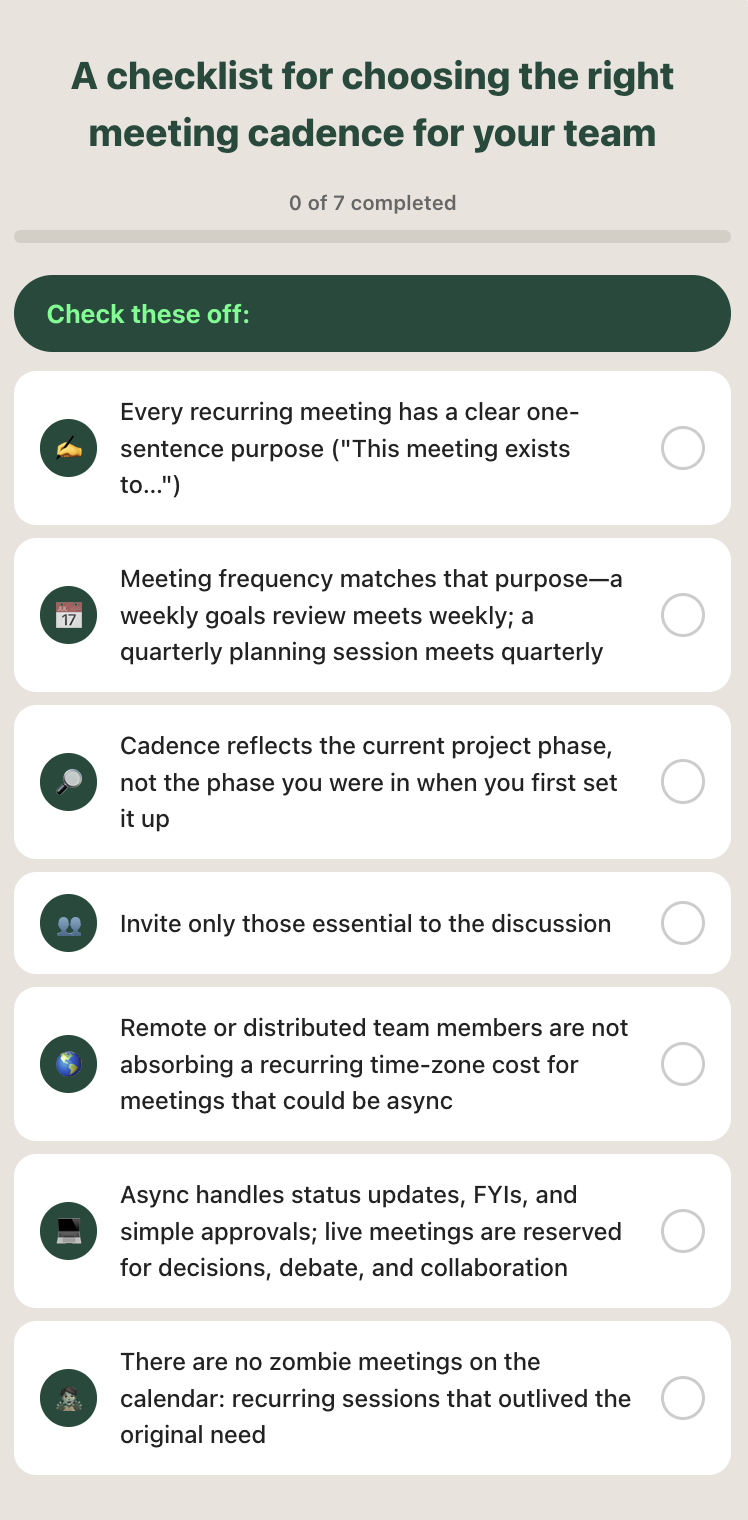
Before you set your meeting cadence, check these off:
By now, we’ve covered how to choose the right meeting cadence, spot when it isn’t working, and adjust it before it becomes calendar clutter. But there is one practical piece left: scheduling.
Even the best cadence can become a burden if you’re arranging every meeting manually. The admin overhead of coordinating your team’s availability (and time zones!), sending meeting reminders, managing reschedules, and following up can really drain your time and energy. Look, there’s no need to do all of this manually thanks to online scheduling tools like YouCanBookMe (YCBM).
With YouCanBookMe, you can:
- Create booking pages for different meeting cadences: Set up customizable booking pages for different types of recurring meetings, from weekly client check-ins to monthly team reviews. You can offer different appointment types, meeting lengths, locations, and availability rules, so each cadence has its own clear structure instead of being managed manually.
- Set your availability once and let people book themselves: Instead of going back and forth to find a time to meet, you can share a booking link that only shows the times you are actually available. Team members, clients, or prospects can choose the slot that works for them, while your calendar stays protected by your availability settings.
- Send automated reminders and follow-ups: YouCanBookMe can automatically send confirmation emails, reminders, and follow-up messages, helping reduce no-shows and keeping recurring meetings on track. For ongoing cadences, this means you don’t have to manually remind people, chase attendees, or send the same follow-up after every session.
- Protect focus time with buffer time and booking limits: A good meeting cadence should not take over your entire day. With buffer time, minimum notice periods, and daily booking limits, you can create breathing room between meetings and make sure recurring touchpoints don’t crowd out deep work.
- Distribute recurring meetings fairly with round-robin scheduling: For team-based cadences, YouCanBookMe’s round-robin scheduler helps keep scheduling fair and efficient by automatically rotating bookings across your team. Customers, candidates, or clients can see more available times and book instantly, while meetings are assigned in the background based on the round-robin style you choose—whether that means optimizing for availability, giving everyone an even share, or following a specific sequence. The YouCanBookMe Team Plan gives you all three options, plus the admin controls to manage it across your whole team!

Automate your meeting scheduling
Stop spending time on back-and-forth emails to find a time to meet. Set your availability once, share a link, and let your team or clients book in directly.


The right meeting cadence isn't a fixed formula. It's something you design, test, and refine as your team and workload evolve. Start with purpose, be honest about what isn't working, and build in a regular moment to reassess.
The part most teams get wrong is the operational side. A cadence only holds if the scheduling stays frictionless. With YouCanBookMe, you set your availability once and share a booking link with your team or clients. They book directly into your calendar, and the tool takes care of the rest: confirmations, reminders, follow-ups, and easy rescheduling when plans change.
FAQs
What is the best meeting cadence for a remote team?

Remote teams need more intentional cadences to replace the spontaneous conversations that happen in an office. A solid starting point:
- Weekly team sync (30 to 45 min) for alignment on priorities, blockers, and progress
- Daily async standup for a quick update via shared doc or messaging tool, keeping day-to-day communication out of live meetings
- Bi-weekly 1-on-1s for maintaining individual connection without overloading calendars
Whatever you land on, protect blocks of focus time between sessions.
How often should a manager meet with their team?
There's no single right answer, but here's a framework that works for most teams:
- Weekly team meeting for ongoing alignment on priorities, blockers, and progress
- Weekly 1-on-1s for new hires, anyone in a challenging project, or fast-moving work
- Bi-weekly 1-on-1s for experienced team members in a steady rhythm
Frequency matters less than consistency. Pick a cadence, protect it, and adjust only when the work genuinely demands it.
What is a good client meeting cadence?
Client cadence typically follows the relationship stage. Weekly or bi-weekly at the start of an engagement, to establish expectations and catch issues early. Monthly check-ins once things are running smoothly. Quarterly business reviews for longer-term partnerships. A scheduling tool like YouCanBookMe makes it easy to keep these touchpoints on track as clients can book directly into your availability without any back-and-forth.
Can you have too many recurring meetings?
Yes, and most teams do. According to Atlassian, 78% of people say they attend so many meetings that it is hard to get their actual work done. Recurring meetings tend to outlive their usefulness. A quarterly audit helps: for each recurring meeting, ask whether it still has a clear purpose, whether the right people are in the room, and whether the frequency still matches the pace of the work. If the answer to any of those is no, adjust or cancel.
What is the difference between a standup and meeting cadence?
A standup is a specific type of cadence meeting: a short daily check-in (15 minutes or less) to surface blockers and align the team on the day ahead. Meeting cadence is the broader system—the full rhythm of recurring meetings across your team, from daily standups to quarterly planning sessions. Think of cadence as the system, and the standup as one component within it.
How do you prepare for a recurring meeting?
Good meeting preparation starts with a clear purpose, a focused agenda, and any pre-reading shared in advance. For recurring meetings, preparation should also include reviewing previous action items, confirming who actually needs to attend, and deciding what outcome the meeting should produce. The better the preparation, the easier it is to run a meeting that stays focused and useful.

Written by
Paulina Major
Paulina Major is a freelance B2B content writer who has spent the last two years deep in the world of scheduling — writing about booking best practices, time management, and the tools that help small businesses run more efficiently. She writes from experience: as a solopreneur managing her own clients and calendar, she lives the challenges her readers are trying to solve.
Get started today
Join thousands of coaches, consultants, and entrepreneurs who use YouCanBookMe to power their business. Get your first booking in a few minutes.


 4.7 / 5 — Trustpilot

